Category: basics

  • Wish List

    Things I wish I had spent more time on as a student:

    • Sight reading
    • Scales in intervals of a sixth – and sevenths and ninths! There are too many of those intervals flying around in contemporary music.
    • Improving my writing skills
    • Yoga or sports
    • Learning acoustics. I wasted a lot of time trying to blow, blow, blow in order to play loudly. A little studying to understand how the flute sound is produced and travels will really help.
    • Practicing piano or harpsichord to keep up my keyboard skills. They do come in handy, especially for arranging and teaching.

    Oh dear, this list could go on if I list everything I wish I had studied more of (traverso, Jazz), and it will lose the thread of attempting to make a sort of temporal commentary on my past, hopefully with some relevance to students of the present. Besides, one does not have to be a student to study these things.

    Things I wish I had spent less time on:

    • Worrying
    • Studying for academic stuff that would go in and out of my short-term memory. (OK, grades are important for academic scholarships and grants, or if you are going to continue studying. But if getting a playing job is your next step, consider signing up for something physical instead of academic.) Nobody looking to hire me as a flutist has given a crap that I graduated summa cum laude from the University of Pittsburgh way back in the 20th Century.
    • Soliciting criticism at random. It’s great to play for as many people as possible and to be exposed to many points of view, but the earlier you can choose people you trust to be honest and constructively critical about your abilities, the better.

    These lists will probably grow as my experiences sift through time.

  • The True Range of the C Flute

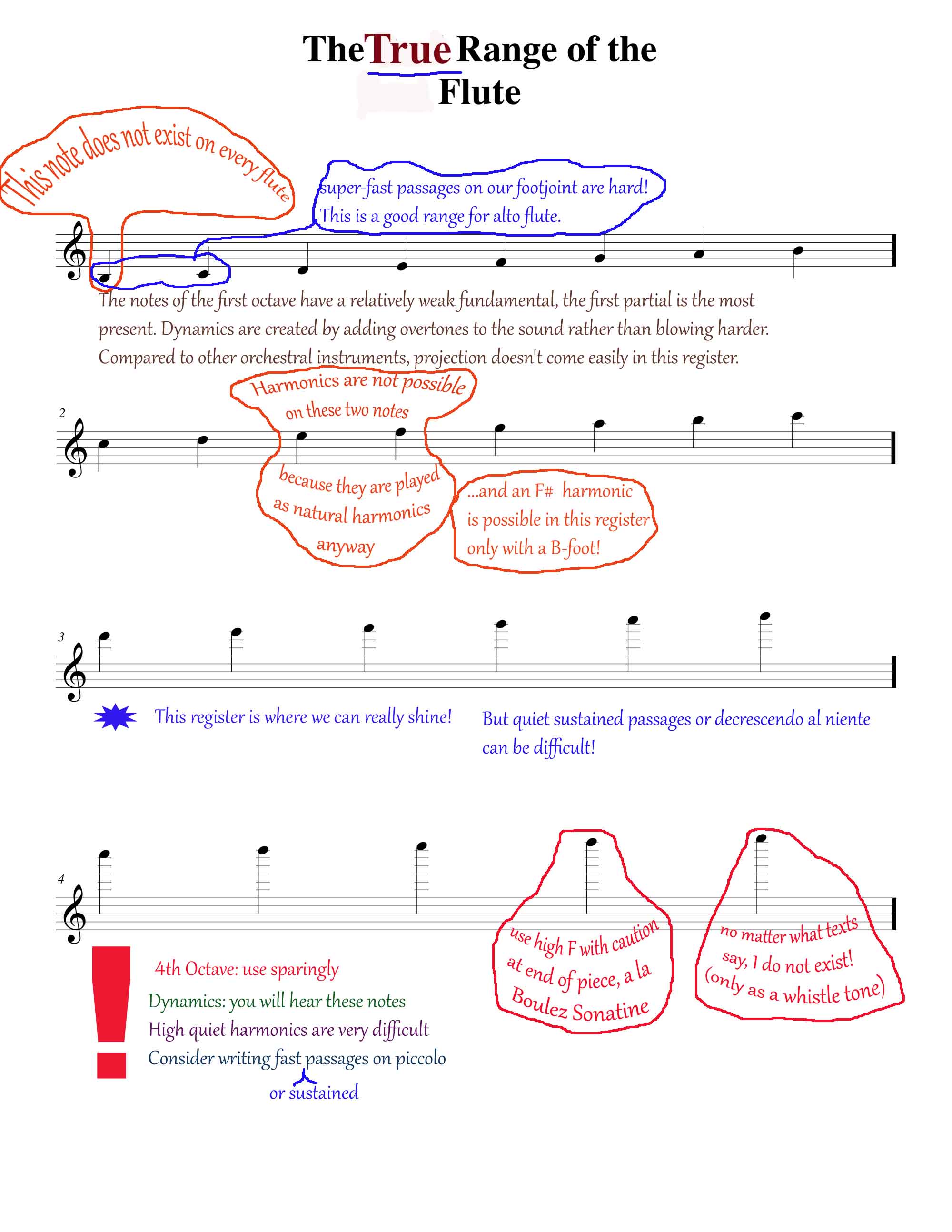
    The True Range of the C Flute

    Back in the USSR, when information was really suppressed, many people were hungry for the truth. Now governments hide the truth from us under a deluge of information. I think composers suffer from this deluge, but it is not a government conspiracy.

    The true range of the concert C flute is a matter of public domain, published in text books, on the internet, and God knows where else as a cold, hard fact. It is neither a state secret nor rocket science. Yet why is it ignored?

    Sometimes I can understand why. We often work with composers of electronic music who transfer their sound world into “scores” and leave the instrumentation up to us. There are also arrangers who don’t sweat the details of register, and tell me up-front that I am free to choose which size flute I want to use when. That’s cool.

    But when that’s not the case, how to bring this issue out from under the deluge information? I considered several options. Swear words, Russell Brand revolutionary rhetoric, sexing-up – what can I do to get your attention?

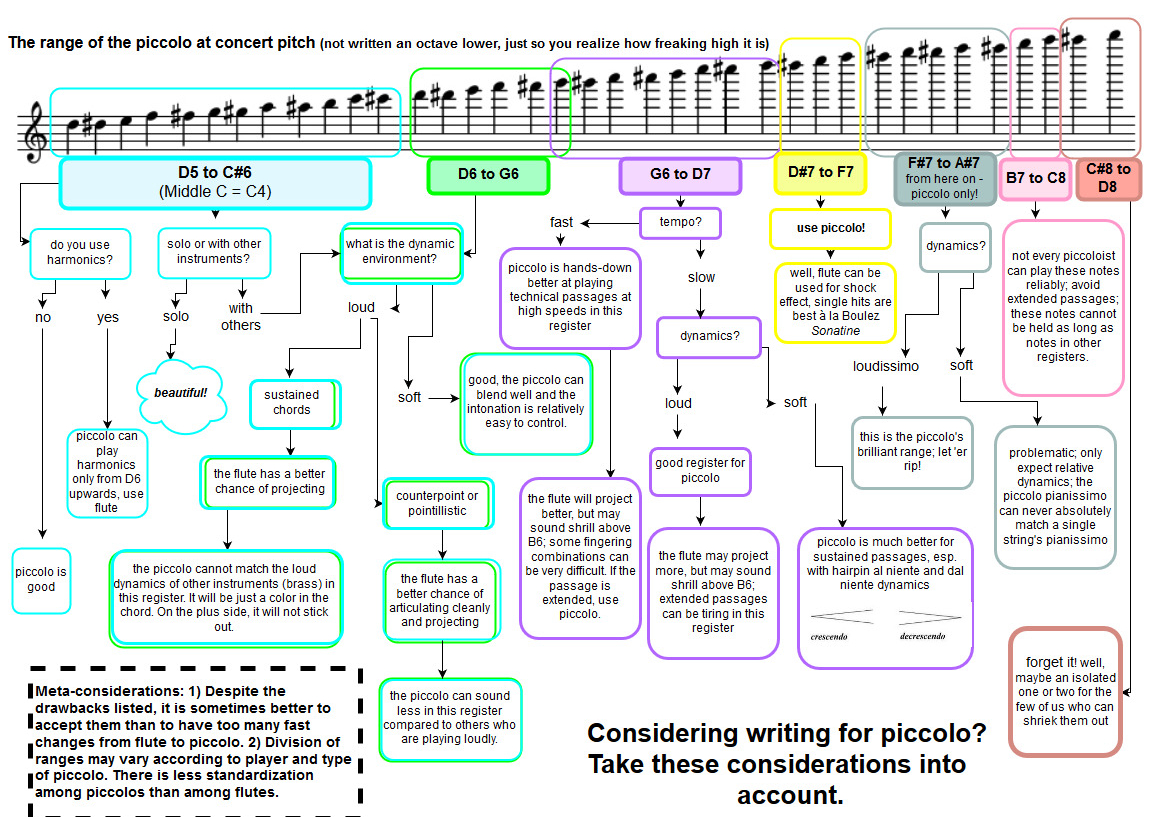
    Here is my first attempt. Download it here as a PDF, or view it here. Suggestions are welcome, but please keep it family-friendly. [later edit: Here you can find a detailed presentation about the range of the flute. Here you can find a graphic of piccolo vs. flute ranges.]

    True_Range

  • Perfection and Procrastination in Daily Practice

    Recently I have spent most of my practice sessions “warming up” and playing exercises. The repertoire I am working on is singularly uninspiring, so this is mostly a maneuver in procrastination.

    But it’s great: taking the time to do and re-do an exercise while focusing your awareness of what’s going on under your skin is never boring. Did I miss that high A? Yes, great, have to do it again. This time keep the air going. The high A takes care of itself. Missed the triplet arpeggio? Good, have to do it again, this time don’t loose connection to left arm. Damn, time to do repertoire….just one more exercise, though.

    I remember Pat Morris, piccolo and Feldenkreis teacher, setting the shoulders of a student to rights. After the student played again she said, “see, you improved without having to practice!”  As followers of the Alexander Technique rightly point out, it is the opposite of “If at first you don’t succeed, try, try again”. Instead: “If at first you don’t succeed, never try again, at least not in the same way”. That is what I like to think what I am doing with my exercises. Sometimes I play without a mistake, but it is not perfection I am after.

    In know, I know, I should carry this attitude into the repertoire-learning part of my practice. To comfort myself (and further procrastinate) I carry a book with me to practice sessions: Pedro de Alcantara’s “Indirect Procedures – a Musician’s Guide to the Alexander Technique”.

    The objective of daily practice should be to cultivate the best possible use of the self on a general basis, and to apply it correctly on a specific basis …In other words, working on right living should take precedence over working on right playing.


     Patanjali (author of the Yoga Sutra) would probably agree, and he would have certainly something to say about my procrastination. Most wisdom traditions teach the concept of non-attachment (which I suck at). What often gets missed is that they also teach one to practice non-aversion (which I have a slightly better chance at). In the end, it might be the approach of the concert date which changes my attitude. So much for wisdom.

    One last quote from Pedro de Alcantara:

    I believe there are four separate but interrelated factors … in achieving truly free action: giving up trying, giving up judging, ridding yourself of hesitation and eagerness, and timing your actions precisely.

    Here I have a chance in hell of making some sort of progress 🙂


  • Are intervals born of air or lips? Let the leopard decide.

    Are intervals born of air or lips? Let the leopard decide.

    On forums and in masterclasses there has been a lot of discussion about which element plays a more important role in producing intervals on the flute. Aside from the change of fingering, do we change more with the lips, with the air speed, or with air volume?

    Take the fingering element out of the equation and try playing through the harmonic series on low C or D. How do you produce the upper partials?

    The trend these days is to say the air makes the changes. Emily Beynon makes a good example and case for air speed:

    In this (long) masterclass series, Phillipe Bernold has a student start the day on a rising dominant 7 chord. Here he suggests the most important thing to start the day is to wake up the air column. There should be a natural increase of both volume and speed of air as you ascend. The lips stay neutral. This is very important for legato.

    Here is why I agree that the air, either volume or speed, rather than the lips should play the major role in interval moving. Please note I do not deny that the lips must remain flexible, and that exercises for suppleness also include playing intervals and harmonics (at least some of mine do).

    As humans, which is more necessary for survival, fast reflexes of our breathing apparatus, or of our facial muscles? Imagine a pre-historic flutist out strolling, searching for good material to build the perfect bone or wood flute. She is set upon by a leopard. She screams and runs. The lightning-quick reflexes of that sharp intake of breath to make sound and to get enough oxygen for the muscles to run is what saves her life. Fast-talking a leopard has been a known fail.

    A Cro Magnon Bone Kingma-System, gimme gimme!!
    “A Cro Magnon Bone Kingma-System, gimme gimme!!”

    So it is my unscientific opinion that the muscles controlling the breathing apparatus, including the diaphragm, have much quicker reflexes, thus can make quicker adjustments than the facial muscles used in the embouchure. Of course, we all know some fast talkers, but they are a scientific law unto themselves!

    Wildlife disclaimer: when stalked by a predator in real life, do not act like a prey animal and run. You will be chased. And caught. Unless they are bees.

    Photo: bigkitten.com

  • Scale Practice – Superlocrian!

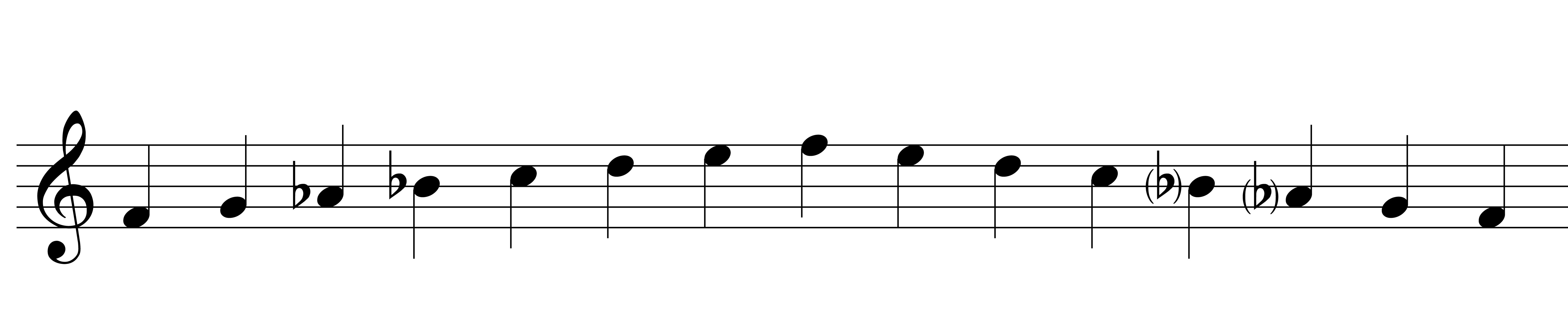
    If you are a diligent scale and arpeggio practicer, you might get tired of the major-minor-chromatic (and seconds, thirds, fourths, etc) routine. I want to share my enthusiasm for my scale of choice this week: the Superlocrian. If you have studied jazz, it won’t be new to you. This scale goes my many names. I actually prefer the term Diminished-Whole Tone, because that is what it is (see below). According to the Wikipedia entry, other names for it are Altered, Dominant Whole-Tone and Locrian flat four.

    First you take the melodic minor scale but don’t alter it coming down. (Yes, you are allowed to do that in jazz!) The modes of this scale are a gold mine for other jazz scales, but that will be another post.

    DWT1a

    Now, start on the 7th degree of the scale, and presto:DWTb

    The first 4 notes are a diminished scale (alternating half and whole steps), the remaining notes form a whole tone scale. How cool is that? Plug this in to Taffanel-Gaubert no. 4 and you have a new flavor for your routine and scale games. There are a number of books for jazz flutists that may have other exercises, but I have not surveyed this literature yet. Any suggestions?

    For more information on the web, especially about the chords that this scale generates, here are some links.

    How to use the diminished whole tone scale by Pete Swiderski

    Reverse engineering our dominant scales by Anton Schwartz (great graphics)

    A diminished whole tone lick by Bob Hartig


  • Robert Winn: Musical Exercises to Develop the Technique of the Tongue

    In many ways this is a book after my own heart. My years as an undergraduate with Bernard Goldberg were fraught with the re-working of my articulation. It would have been very useful to have such a book as this, with its written explanations (provided in English and German), numerous excerpts (some not found in other compilations), and standard as well as original studies.

    When one takes on the task of trying to describe the mechanics of articulation and relating it to one’s native language, there is a risk of getting bogged down in linguistic terminology. For the general flute-playing public I think this book walks the line very well between Too Much Information and the vague “finger-pointing-at-the -moon” sort of stuff you find elsewhere.

    Once you do mention linguistics though, pedants like me crawl out of the woodwork with fingers and tongues wagging. There are several things I would like to wag on. Mind you, I am a pedant, not an expert, so my comments are below in the “Pedant’s Corner”.

    It was very enlightening to read about some of Winn’s key concepts. He points out that some articulation difficulties are linked to the fingers in a way I hadn’t thought about, and going through some of the studies helped me sort that out. The position of the teeth, in front and in back, was something I had also not considered before.

    All in all I enjoyed reading this book as well as playing the studies, although the text could have used a good editor for English punctuation and clarity. (I can’t comment on the German). I do hope that future editions will see to this.

    Pedants Corner:

    1. One basic aspect is ignored, that of aspiration in English and German consonants. If you are an English speaker, you will say the “T” in the name “Todd” differently from the “T” in “stick”. Todd’s “T” is aspirated. The tendency to puff air rather than release it from the mouth can pose a problem for beginning flute students of languages that do this.

    2. In mentioning the tendencies for Russian and Bulgarian, Winn is correct that there is a large build-up of physical tension for the consonant “T”. One reason for that is it is produced with the tongue much further back than in English, touching the alveolar ridge. And it is never aspirated. However, that is only half of the picture. I don’t know about Bulgarian, but each Russian consonant is paired with its palatalized twin, a much softer version. A crude way of explaining this is to imagine the consonant followed by a “Y” (as in “you”) “TY” is very soft, produced very forward in the mouth and is more of a release than an attack. I spoke to someone who believes this linguistic ability is responsible for Denis Bouriakov’s amazing articulation.


  • Paul Edmund-Davies: 28 Day Warm Up Book

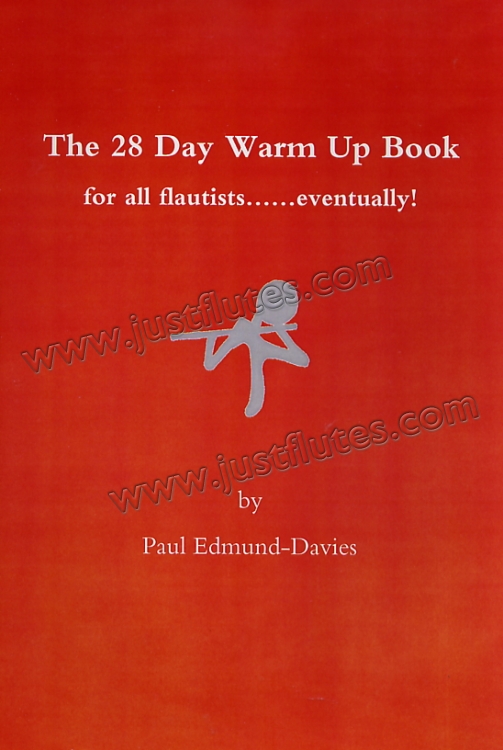
    Paul Edmund-Davies: 28 Day Warm Up Book

    Recently I have enjoyed working from Paul Edmund-Davies “The 28 Day Warm Up Book, for all flutists…..eventually!”. Its (English-only) text is extremely clear, with touches of humor that engage the reader from the start. His approach is extremely practical and humane. There is advice on how to approach your practice, how to structure it, and the empty staff paper at the end of each section encourages further thought and creativity for your own exercises.

    The daily exercises cover four areas: sonority, fingers, articulation and intervals. I felt compelled to write about my experience with these exercises because it is a lesson in humility. With several decades of professional playing under my belt, I took a look at some of the pages and thought “how simplistic, I don’t need that stuff”. But playing them, I realized that they were quite challenging. So I got to work. And they sound nice! My family particularly likes to hear me practice Articulaton no. 7.

    A number of exercises I find useful for piccolo practice. Intervals no. 2 is not only good for intervals, but makes a great intonation study if played with a drone from a tuner or computer. (How I wish I had a live tambura player to assist me :-)). Articulation no 6, with its combination of repeated and moving notes, is especially good for controlling the sometimes tricky middle register of the piccolo.

    The section on fingers I find very practical. He points out that scales are all well and good, but they don’t really train the fingers to lift and close with swift independence. The exercises, some of which are based on Taffanel & Gaubert, reinforce this idea. Because its familiarity makes for easy memorization, I am a great adapter of T&G myself, and am always happy to learn other approaches.

    Here on YouTube, you can watch Paul Edmund-Davies demonstrate some of his exercises in the context of learning Anderson’s Op. 15.

    For those who are interested, my complete warm-up these days goes as follows:

    • harmonic studies, with and without articulation, add trills
    • finger and articulation exercises, including scales and written exercises from this book. As I have written elsewhere, I find Peter Lloyd’s approach works well with me: Get really warmed up first, and then do sonority work.
    • combined melodic sonority/intonation/interval exercises from this book and others

    You see, I have gotten away a bit from long tones. They can be useful, and I may come back to them at another point. But for now, I find melodic studies and other exercises from “de la Sonorite” more useful. Gotta do what works!


  • Breath, Its Infinite Cycle

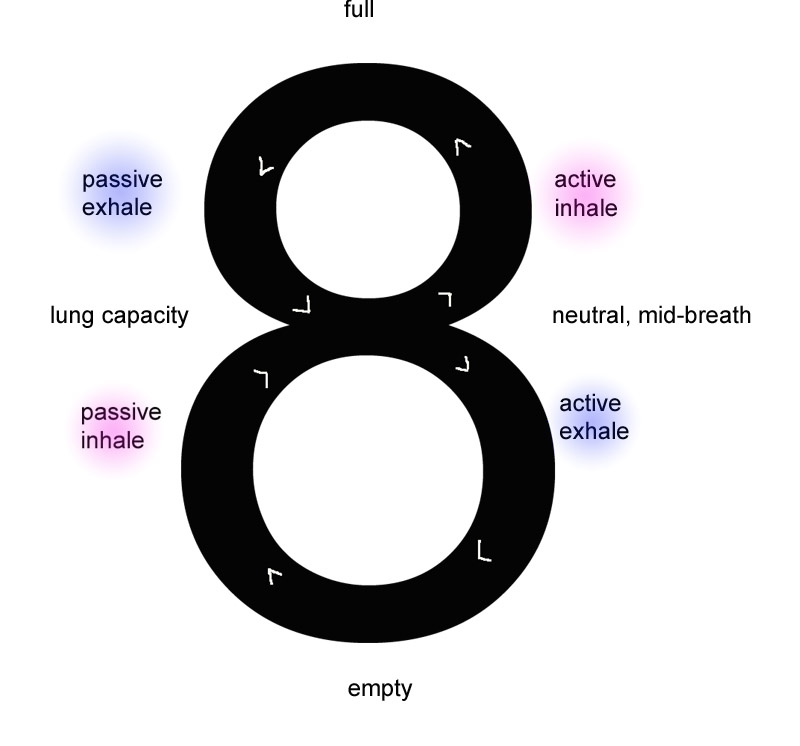
    The breath cycle

    For those who work well with visual imagery, have a look at this adaptation of one of my clever student’s drawings. The mid-point of the “8” represents your lungs as they are when speaking normally, just havin’ a conversation. Michel Debost calls this “mid-breath”, and describes its usefulness in his book The Simple Flute. The white arrowsheads, hopefully discernible on your screen, show the flow to and from this mid-point.

    I love how the figure “8“, when turned on its side, also represents infinity.

    Once you pass this point by actively filling or actively emptying the lungs, it can be helpful to realize that the next natural step is a passive one.  I find this helpful when having to take a quiet, quick breath when playing, say, a fast movement from a Bach Sonata.