Bass and Alto Flute Resource – a gold mine


I want to share with you two websites by Carla Reese that just about say it all when it comes to composing for alto or bass flute.

Alto Flute

Bass Flute

What I appreciate are her explanations about the dynamic capabilities and limitations of these flutes. I am often frustrated by composers who write ensemble works and choose these flutes for their range only, rather than for their timbral capabilities. Often, I am expected to match the dynamic environment of my colleagues playing trumpet, (bass) clarinet, bassoon, and English horn – instruments that more or less match the range of these flutes. When frustrated, I have been known to peevishly remark to the composer, “a saxophone would have served your purpose better.” The inevitable response is:”but I love the color of these flutes.” “Well then write so that you can actually hear the color of these flutes”, is my usual unspoken response.

As Carla explains on her site, “Dynamic range, and projection, on the bass [and alto] flute[s] is controlled predominantly by tone colour rather than actual dynamic”. She further provides a spectral analysis that compares the sound of the C, alto and bass flutes.

If you are considering writing for bass or alto flute, especially in an ensemble situation, please read her pages!


Share

Some thoughts on composing jet whistles


Jet Whistles on the flute can be amazingly effective, but one has to compose them with care. You can hear a sound file here on Mats Möller’s website. He calls it “Strong air stream without tone”. Two composers who use jet whistles effectively in ensemble situations are Helmut Lachenmann (Mouvement, Zwei Gefühle) and Bernhard Lang ( DW 9 Puppe/Tulpe) -  you might want to check out their notation and usage.

A few basic pointers:

  • Jet whistles need time to set up. The flutist has to go from normal playing position to inserting the entire lip plate into his or her mouth.. (insert dirty joke here…) You can sorta, kinda do it with the lips just covering the hole, but it doesn’t have the impact. To be on the safe side, make sure there is a rest before and after the jet whistle.
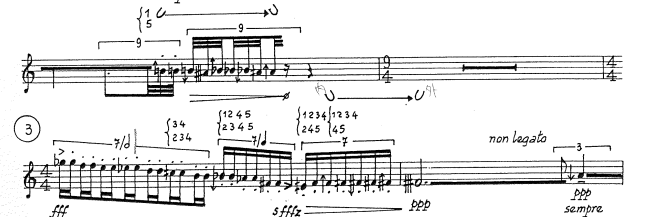
  • A jet whistle is a quick blast of air that can begin with an ascending pitch or a descending pitch. Graphically they can be /, \, /\, or even \/, although you need a lot of air for that one (at least I do).
  • Quick is the operative word here, especially if you want something that will carry in an ensemble situation. I have been asked to do slow ones, which are possible if you don’t need a high pitch and if you don’t need to project the sound. In other words, it has to be a quiet environment. I would even go so far as to argue that what I would be doing in this situation is colored air noise, and not a proper jet whistle.
  • It is not possible, in my experience, to notate the exact resultant pitches. A graphic representation is the nicest way to go about it.
  • Jet whistles only really work on the C flute, not on piccolo, alto or bass. One can make whooshing sounds and all kinds of colored air noises in these flutes, but for whatever acoustical reasons, a true and dirty jet whistle just doesn’t work on these flutes. A recent informal survey among flutists of my acquaintance confirms this.

Any flutists out there with any thing to add?


Share

Bass Flute ins and outs II – for composers


Since my last post about composing for bass flute, I’ve taken note of other questions that pop up with regularity.

Q: Should I notate the pitches as sounding or transpose up an octave?
A: Please transpose them up an octave. Flutists are not used to reading ledger lines below the staff.

Q: Can a bass flute play glissandi?
A: Yes. There are two things to be aware of though.
1) Most bass flutes don’t have open holes like normal C flutes, so research with your local flutist if you want a smooth glissando over an interval larger than a minor second. From a middle C to E-flat, and the C to E-flat an octave above, the flutist can use the trill keys to effect a good glissando.
2) A long tube means the pitch is more difficult to manipulate. Unlike the piccolo, which can go out of tune if you look at it the wrong way, a bass flute requires more effort to bend the pitch. In the lowest octave, where the tube is the longest, a lip glissando of a quarter tone is about the easiest one can do. A lip glissando of a  larger interval can be done if you allow the dynamics to help you. To let the dynamics help: use decrescendo for a downward slide, and a crescendo for an upward slide.

A bass flute by Eva Kingma with open holes. Not every flutist is lucky enough to have one.

The third octave of the bass flute is easiest for glissandi. Here you can use a combination of lips, adding or lifting keys to get a good glissando. For the exact range of a glissando on a particular note, it’s best to check with the flutist for whom you are writing.

Q: Can a bass flute play microtones?
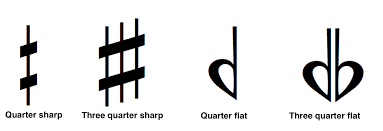
A: Yes. Third tones, quarter tones, and sixth tones are all possible. (Actually, the smaller intervals are easier, for me at least.) Since most bass flutes don’t have open holes, there are basically two ways to produce microtones:
1) De-tune a normally fingered pitch by turning the flute in or out and adjusting with the lips. The lowest notes from its lowest C to E-flat (an octave below middle C) have to be done this way (see question above as to why that could be problematic).
2) Using a special fingering, usually a “shaded fingering” or “forked fingering” that adds keys to a normal fingering.  These fingerings tend to sound very unstable and diffuse (it’s a cool sound, but not always what you need).

Q: What about fast passages with microtones?
A: Beware of writing fast passages with microtones. On any flute, not just bass, learning a fast passage with non-standard fingerings will take the flutist not only twice as long, but I’d say up to ten times as long. That’s fine if you are investing time in a solo work that will get a number of performances and you are sure every note will be heard and count for something.

Q: What about playing fast microtones with just the lip or turning the flute in or out?
A: That’s fine if you have only quarter-sharps or only quarter-flats. Otherwise, you will have a good laugh watching a flutist bob his head in two directions at once. If you are lucky, the flutist will not bang his headjoint against his front teeth and claim liability.

Share

Air & Percussive Sounds for the Flute


 This entry is cross posted on the musikFabrik blog

This video gives a brief demonstration of some common air sounds and percussive effects on the flute.

Here are some further tips for players and composers:
For players, when doing air sounds, it is not always necessary to use as much air as possible. After a long, loud passage, you might find yourself passed out on the floor! The trick here is to make as sibilant a sound as possible. One way of doing this is to actually narrow the throat a little to make the air passage smaller (I know, just the opposite of what we all learned!), then raise the tongue a little, so that it disturbs the distribution of air wanting to escape from your mouth. These are subtle adjustments, you needn’t do too much. All you are doing is speeding up the air, as when you narrow the end of a garden hose to make it spray further. For loud passages, you will still need to give extra support from down below, putting your abdominal muscles into play.
The pizzicati sounds will be louder and more resonant if the flute is turned out a bit. The more you can make resonance in your own mouth, the better. For maximum resonance for key clicks, stay in playing position, open your throat as far as possible, and open your mouth just a bit more over the embouchure hole to create an extra resonance chamber.

I have posted some further information on the production of tongue pizzicato here.

For composers:
There is unfortunately no standarisation of notation for these effects. I have shown on the video those recommended by Pierre-Yves Artaud in his book Present Day Flutes. I find these to be quite intuitive, but maybe another flutist will have another opinion.
When notating air sounds for the flute, please avoid using empty note heads, unless an empty note head is rhythmically called for (a half note, dotted half note, or whole note). I know, Helmut Lachenmann, Isabel Mundry, and other well-known composers use open note heads, but it makes their music extremely frustrating to read. I am hoping that this tradition will die out. (For more about this and to see written musical examples, read my blog entry here.)
Key clicks on the flute fall into my “Why Bother?” category. Unless you carefully compose them in a solo work, or under amplification, you won’t  hear them.  95 % of the time, I end up having to reinforce them with a tongue pizz. Helmut Lachenmann’s Mouvement is an exception, there are some passages with pure key clicks that can actually be heard! However,  other passages in that piece that need the reinforcement of a tongue pizz.
Note that the difference between a tongue pizz produced on the palate and a tongue pizz produced on the lips is not very distinct. It may be best to let the player decide where to produce the pizz. Some can do it on the palate better, others more effectively on the lips. However there are circumstances, such as close amplification, where that small difference can be quite interesting.
Now, if only I could beatbox…..

Share

Trouble-shooting problems between composers and performers


There are several categories of potential trouble areas between composers and intstrumentalists:
1) Basic orchstration mistakes
2) Unfamiliarity (on either side) with a particular extended technique or effect
3) Unclear notation

What I am about to say may seem a bit didactic and Miss Mannerish, but really, it’s common sense. And as you may gather, I’ve had enough bad experiences to know what works and what doesn’t. I’m all ears for other ideas though.

Flutists, unless you are dealing with a composer/performer, you are the expert of your instrument and in a possible position to educate the composer. See your role as that of an educator, but use it with care because no one likes to feel patronised. To say simply “this is impossible” is very unproductive, even when it comes to a simple mistake such as a low C on the piccolo.

When faced with difficulty, the first step is to find an alternative. It is sometimes useful to take the initiative and suggest one yourself. As in all possible conflict situations, it is better to retain the “I” message rather than the “you” message. For example: I naively expect composers to know basic orchestration rules for flute and piccolo; therefore I am constantly disappointed. What to do? Some example suggestions: “could I take this low C up an octave? My standard piccolo only plays to low D.” or “given the (lack of) time we have, I would much prefer to play this rapid 4th octave passage on the piccolo rather than on the flute.” or “on this high C, I can achieve a much nicer pianissimo on the piccolo rather than on the flute.” The composer will most likely get the idea.

Articulation of staccato notes is another difficulty I run into with composers (and even conductors). On the lowest notes, the flute has a long resonating tube, and this takes time to speak. Some head joint cuts are designed so this register speaks loudly and easily. One can always strive to do better, and there are many exercises for the improvement of this technique. However, if you run into serious trouble trying to match the length of notes with string instruments or electronic sounds, you do have an acoustical excuse. If you see an alternative, suggest it. If not, express your willingness to work on improvement, but show the composer the length of tube required to resonate (and thus the physical limitations).

Often, when puzzling over an extended technique, rather than say “this is impossible” or “I can’t do this”, it helps to ask what the composer actually wants acoustically. Is there another technique which you can do which would be just as or more effective? Or ask where s/he got the technique from. Was it from another player whom you could simply contact for advice? Was it from a book? Were acoustical considerations overlooked such as the difference between a B foot and a C foot, or the difference between any two flutes or flutists?

Most composers I have worked with are very open and eager to look for solutions together. I once experienced a misunderstanding in an ensemble piece where I was faced with a passage of rapid, high whistle tones (notated exactly so: “whistle tone”) marked forte. The composer, Beat Furrer, actually wanted these sounds loud, which is an acoustical impossibility. He insisted, however, that the previous player had achieved this. I asked him what the previous player had actually done, then tried out a few things according to his description. It turned out that what he wanted were overblown harmonics with a lot of air, which in the context of this ensemble piece did give a whistling effect. So these effects were not whistle tones as I had learned them, nor as they appear in textbooks. I pointed this out to the composer, who did not take my point or make any “correction” in the part. As long as we had found the acoustic solution together, he was satisfied his notation had produced the results he wanted. What to do? In this case, I decided I had done my “duty” by pointing out a possible misunderstanding for the next flutist. To have taken “educator” role too far would have just meant getting into an argument (which I would have undertaken had this been a solo piece).

This is perhaps a long way of saying to my fellow flutists: let’s work together with composers to encourage the following:

  • a more standardized notation for extended techniques
  • a good working score for the next performer who comes along!
Share

Tips for composing and notating aeolian (air) sounds


Here are some tips on the use of air or aeolian sounds:
Be sure to specify if you want these sounds:
A. produced in playing position (so the air goes across the flute and produces a pitch that corresponds with the fingers), or
B. produced inside the flute: i.e., if you want the flutist to cover the embouchure hole and produce a kind of unpitched “white noise”.

Sometimes I am asked to produce type “A” with the specification “no discernible pitch”. This is nonsense: if a flutist blows across the flute they will always produce some sort of pitch. Even with no fingers down, you will get something in the neighborhood of C#. If you want unpitched noise, ask to flutist to blow into or inside the flute (cover the embouchure hole). In this position, the flutist can produce a range of unpitched sounds from bright (higher sounding white noise) to dark (lower sounding white noise) by changing the position of the tongue.

This leads to my next point: the use of different vowel sounds for color effects. This is most effective with the embouchure hole covered (type “B”). A good example is Hans Zender’s Lo-Shu II. Vowel sounds are much less marked in normal playing position (type “A”), so be sure to take care in ensemble situations.

Some general thoughts about notation:
There are several notational traditions from the Artaud and Levine books concerning the notation of “aeolian” or “air” sounds which I would like to ask composers to avoid. When composing these sounds especially in a situation where rhythm is crucial (especially in an ensemble situation) please avoid the notation that uses empty note-heads:

This notation makes the distinction between a quarter note and a half note difficult. When a player is reading, this can be very annoying. It’s good to have a different note shape, but be sure to fill in the note head in when needed so the player can read the rhythms easily:


An easy way to indicate a gradual change from normal sound to air is by using text with a dotted line:


or simply with a filled circle connected to an open circle by a dotted line:

Share

Tips for composing singing and playing techniques


When writing for the flute and voice there are several things to take into consideration.

The first may be: where to notate the voice line?
For solo pieces: if you have an extended or complicated voice line it is customary and practical to use a separate staff below that of the flute line. On the other hand, for short simple passages, I prefer to have the voice pitches on the same line as the flute.

In the context of an ensemble piece, I would use the same guidelines as above, and please be sure to notate the voice line below the flute. As a general rule, it is best to leave free space above the staff for an ensemble player to mark in beats, que notes, or remarks from the conductor.

Another consideration is the distortion produced by the simultaneous use of the voice and flute. The use of the voice (as most of you know, I am sure) in conjunction with the flute greatly distorts not only the flute sound, but the voice line and any text that you may want to set. Because of this distortion, getting a true polyphony going can also be tricky if you have a complicated passage. In this case, if you want true polyphony, use two instruments. I prefer the use of the voice and flute as a coloristic element, rather than using it as an attempt to create polyphony.

If you want to set text that is understandable to the audience, it is not advisable to ask the flutist to play at the same time as speaking. A better technique would be to have the flutist speak or sing the words using the resonance of the flute only. Beware of text with nasal vowels, these produce no resonance on the flute.

Speaking or singing directly into the flute (with the embouchure hole completely closed) is another option. This of course produces a muffled effect; however, rapid key action will interrupt the muffling and create an acoustic “panning”. This effect can be heard at the beginning of George Crumb’s Voice of the Whale

Some examples of the most effective uses of flute and voice are Noa Noa by Kaija Saariaho for flute and live electronics, and Toru Takemitsu’s Voice .

When using a vocal line with the alto flute, there is the option of transposing the vocal line or writing it at pitch. Personally, I prefer having the voice line transposed with the alto flute. Since I have only a relative sense of pitch, it makes sense for me to have the voice always referring to the alto flute pitch; although, if the flutist for whom you are writing has a strong sense of perfect pitch, it would be better to write the voice part at pitch.

Share

Extended Techniques, Blessing or Abomination?


I am astonished by the occasional vitriol I encounter from some prominent flutists when it comes to extended techniques such as multiphonics, circular breathing and so on. They chant the same nonsense: “bad for your embouchure”, “waste of time”, “don’t be one of those players”. After over 20 years of experience with these techniques as a player and teacher, I am convinced of their benefit to traditional playing. But that’s not what I want to post about. I would like to approach this question from another angle.

Some years ago in an active network forum a very prominent flutist remarked that flutists who can circular breathe belong to a certain class of players whose time would have been better spent working on learning to play properly. I won’t delve into the implications here. It made me livid. I spent 11 weeks in 1992 learning to circular breathe, did that hinder me from playing properly? How idiotic! This person has somewhat recanted this initial statement, but the shadow of stigma still applies in some circles.

Now I have 5 years experience teaching at the conservatory level, and I’ve begun to understand this attitude. I won’t say I sympathize, but I understand it enough to offer some insights which I hope will help students, teachers and composers. There are two issues, as I see it.

The first is a basic misunderstanding. Here is an illustration – this semester I had a student who was swamped with student ensemble compositions and several 20th century repertoire pieces. After this period, she came to me with an 18th century work. The sound was bad, no focus, articulation stuck, breathing shallow. She had tied herself into knots because of the difficulty of the contemporary works, which included circular breathing, microtonality and switching to alto and bass flutes. A typical teacher’s reaction would be “OK, see what that stuff does to you? No more!” But folks, the music itself is not at fault, it was the student’s attitude toward it that stressed her and put her practice into panic mode, causing physical problems that set her way back.

That can happen with any repertoire. It can happen when you first learn to play the piccolo. Good and balanced practice on the piccolo can help and enrich your flute playing, as can good and balanced practice of extended techniques. Managing the airstream and angle for piccolo playing is also an extention of flute technique. Exercising the same management for multiphonics is not such an “out-there” thing.

It wasn’t for nothing that Aurèle Nicolet always said: “You must play Baroque music every day, you must play Bach every day!” If you practice extended techniques as a true extension of good practice out of good flute technique, you won’t fall back, or at least if you do, the recovery time will be very quick.

However, there is another aggravating element, which leads me to the second point, the disparity between composing and performing. Student composers don’t necessarily need endless years of training to write very complicated music. Student instrumentalists and singers need decades of training before they acheive the level it takes to play a complicated piece it took a student composer only one semester to write. I’ve put this rather crudely but you get what I mean. Since being a composer-performer is not really encouraged by the conservatory system, this artistic link has been severed. Our only hope is diplomacy! Communication of the issues of difficulty is very important. Encouraging an us-versus-them attitude will make the situation for both worse.

When a flute student is first exposed to contemporary techniques at the conservatory level, it is likely s/he will be overwhelmed because that first exposure may be a standard repertoire piece written for a professional [think of all the works written for Pierre-Yves Artaud, Robert Aitken, Roberto Fabricciani and so on], or written by a student or faculty composer who assumes that level as the norm. The student is frustrated, the teacher, if inexperienced, is also frustrated and there’s another black mark against contemporary music. The earlier good, measured, positive exposure to extended techniques, the better.

Share

Flute Multiphonics – Q&A for composers


Q: Should I write in the fingerings for multiphonics?
A: Yes. It saves time. It saves misunderstandings. Books go out of print, so please avoid naming multiphonics by number. I know writing or drawing in multiphonics can be a pain. If you have many of them and want to save time and ink, you could write the multiphonics with fingerings in your performance instructions so you need not repeat the fingerings in the score.

Q: How should I notate the fingering?
A: Robert Dick has the most intuitive system, it is just a template of the layout of the flute’s keys. Carin Levine and Pierre Yves Artaud don’t draw the trill keys but refer to them with the letters “A” and “B”. A flutist unfamiliar with these books (esp. if they get out of print) won’t know what to do. If you need a template, you may use the jpg below (taken from Robert Dick’s Flying Lessons):

There is also a cheap downloadable font for Sibelius, Finale and text editors available here. I haven’t tried this out myself, so I don’t know how easy it is to use, but I like the results.

Q: Which multiphonic resource should I use?
A: At the time of this writing, I would most highly recommend Robert Dick’s The Other Flute and Carin Levine’s The Techniques of Flute Playing. Do not use Bruno Bartolozzi’s New Sounds for Woodwinds.

Unless you are a flutist yourself, I would not advise using The Virtual Flutist. When a resource shows every single pitch that can be produced by a certain fingering, it doesn’t necessarily follow that a multiphonic can be created from these pitches. Try it with a live player before trusting a theoretical projection of the flute’s acoustic response.

Q: Can I just notate the main note and leave the multiphonic up to the player?
A: Sure! Be aware though that on the lowest notes only harmonic multiphonics are possible. In layman’s terms, multiphonics are made possible by venting the tube at a certain location which causes the note to split. Low notes need the long tube of the flute. If we vent a key, we shorten the tube: therefore no low note. In short, the best range for “free” multiphonics is the middle register and up to the flute’s 3rd octave B-flat. At least that is the most comfortable for me.

Q: Can you trill a multiphonic?
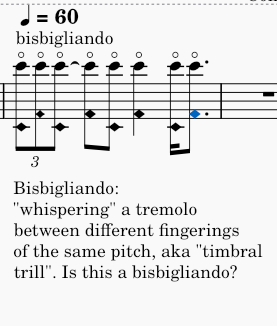
A: Depends. Almost all have the possibility to do at least a timbral trill. Check with your local flutist.

Q: Can you fluttertongue a multiphonic?
A: Yes. Some very close multiphonics are actually easier with fluttertongue. This is assuming however, that the flutist can fluttertongue. It’s not always a given.

Share