Category: practice

  • Spectral fun with Hyena

    Advice on how to prepare the microtonal, spectral works for large ensemble and orchestra of Georg Friedrich Haas and other spectral composers.

    These remarks are a culmination of my years of experience playing spectral works and coaching the academists at the Grafenegg Festival 2026 for the premiere of Hyena II for Orchestra and Storyteller under the direction of Ilan Volkov. (See also important changes to the first flute part towards the end.)

    Figuring it all out:

    This is an example of the notation we were faced with:
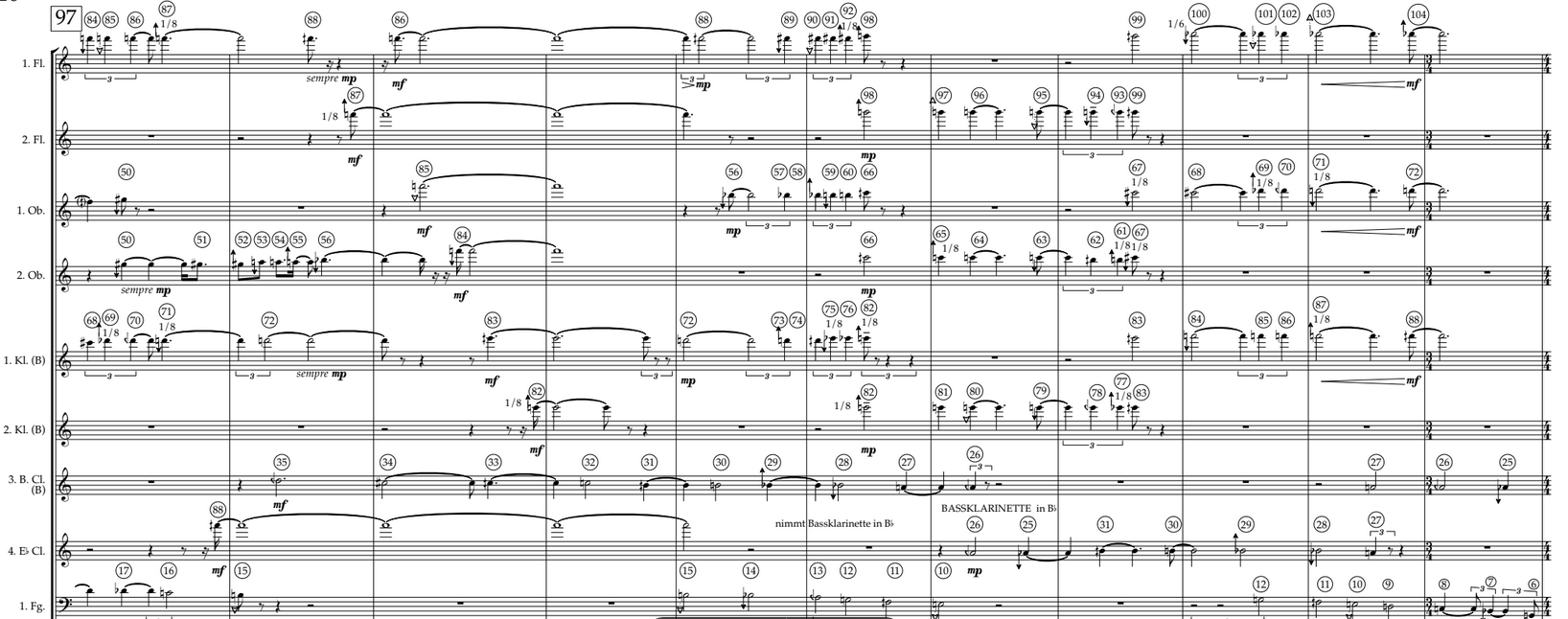
    Haas was very considerate in providing the following approximate accidentals:
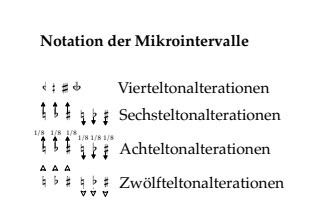
    Translation: Notation of Microintervals:

    Quarter-tones, sixth-tones, eighth-tones, and twelfth-tones respectively

    Using these accidentals is a practical strategy for large orchestras. The indications allow players not familiar with spectral music to rely on their instincts to at least approximate the pitch. However, the circled numbers above the notes indicate the partial number and therefore the true pitch.

    These partial numbers represent a position in an overtone (harmonic) series based (in this piece) on C0. Here I use the terms harmonics, overtones and partials interchangeably, although there are some subtle differences. Note that because this is a mathematical series that starts with 1 (not 0), the 1st partial IS the fundamental.

    So the first thing you need to know for playing a harmonic series is: what is the fundamental? The score says only ca. 16 hz as an indication, because this will change according to what your group tunes to – A=440 or higher.

    Once you know that fundamental, you “only” have to multiply that number by the circled number above your note. That gives you your frequency. However, for many musicians, it is easier to think in terms of cent deviations, where the half step is forther divided into 100 equal steps. Modern tuning apps give us cent indications, so they have become a way many of us think when it comes to being sharp or flat.

    I can understand a composer not wanting to put a cent deviation above each note of an orchestral score, that would indeed be messy. But it would have been practical to have this chart from Wikipedia, for example, in the performance instructions:
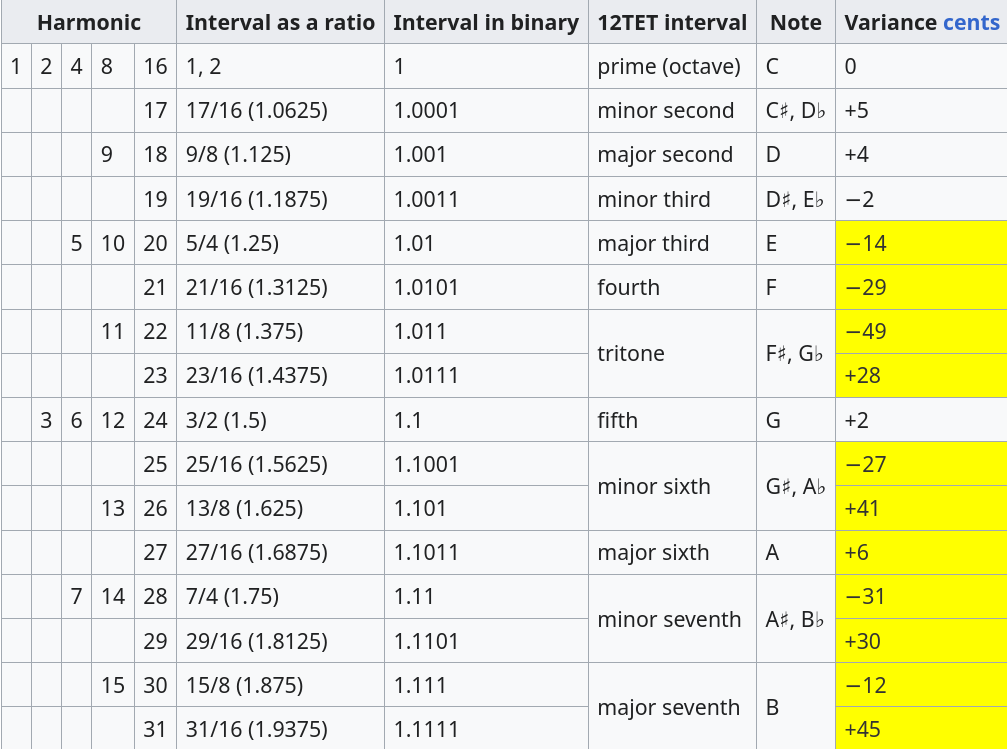
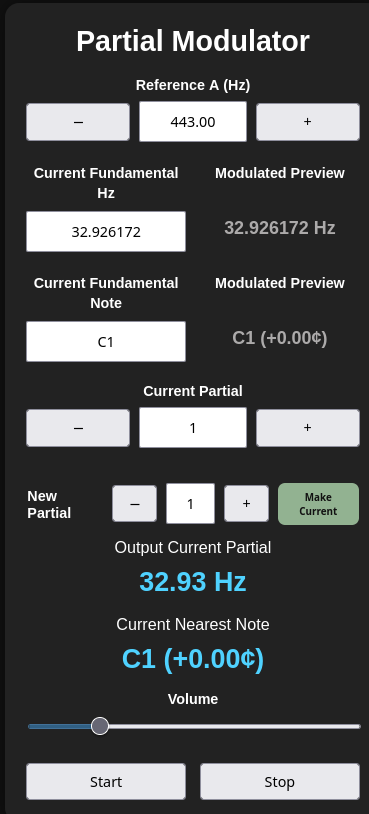
    In order to make all this easier, to calculate the partials above 31, and to have a quick alternative to view these notes according to cent deviations, I created this app:

    Here is the link
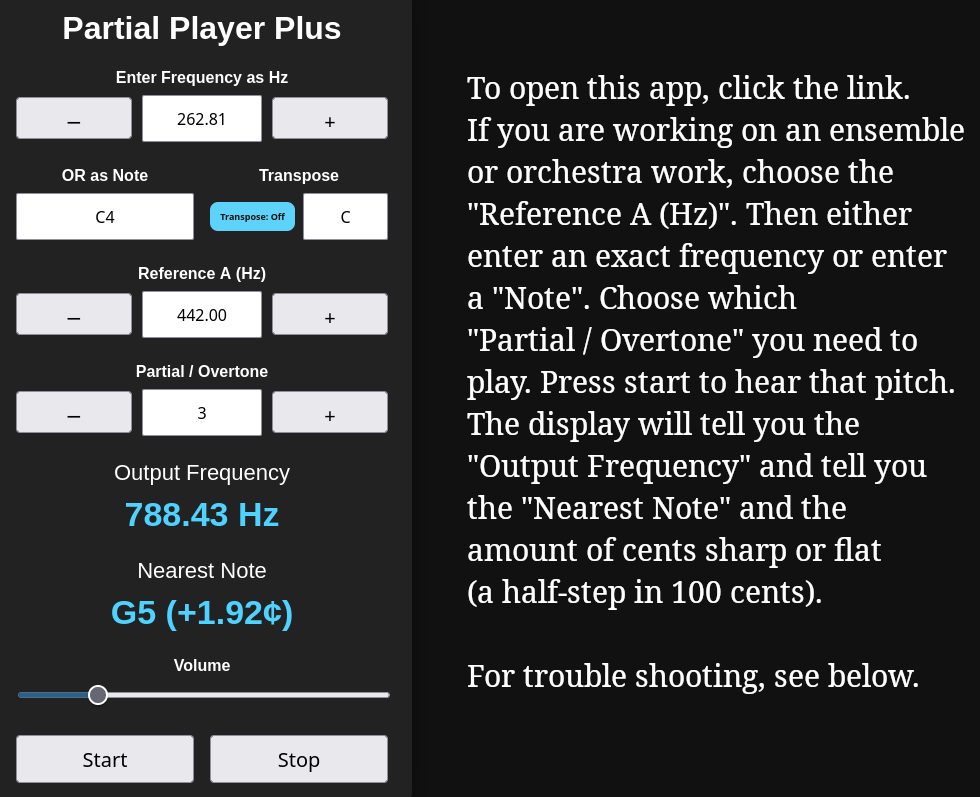
    Note that the transpose feature will only change the “Nearest Note” display!

    Troubleshooting for Partial Plus app:

    • – Make sure JavaScript is enabled on your browser (see your browser settings).
    • – Low frequencies need a lot of volume boost,
    • – If your ringtone is muted, this may mute the sound of the app too. For iPhone, there is a small button on the side of the phone, on the upper left.
    • – If you have an old phone (iPhone 11, for example) it just may not work. Use an iPad instead (or laptop).

    Knowing what frequencies to play and what fingerings to use is only part of the work. There are two other important factors: listening and sound quality.

    Listening:

    Despite the mathematics involved, this work, and many other spectral works, involves listening, being able to hear and predict your pitch from either the fundamental or the fifth (which you can hopefully hear or remember).

    With the app (or any listening aid), I recommend listening up to the first 16 partials. If you want to challenge yourself to a new scale exercise, learn the partials 8 – 16 in all keys. (It’s kind of a whole-tone bebop scale :)) I am developing other exercises for listening, recognizing, and playing partials, so stay tuned.

    To become confident in this piece, you really need to hear up to the 13th partial. If the instrument playing the fundamental is sharp or flat, you may not be able to rely only on a fingering you learned, you have to be able to adjust in real-time using your ears. Remember, if you have to play the 2nd, 4th, 8th, or 16th partial, that is just an octave relationship to the fundamental. If you have the 3rd, 6th or 12th, that is a perfect fifth relationship. If you don’t get that right, the other players who have to play the partials of a 5th, 7th, 9th, or above will have trouble.

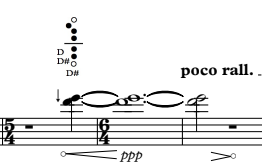
    The very high partials can (at least in Hyena II, say, above 37) be relativized. That is, there is often a play between players, In the passage below, for example, the flutes, oboes and clarinets enter on pitches where each is slightly lower than the other. Tricky, yes! But doable by ear with practice.

    Modulations:

    Sometimes, especially in the works of Haas, the fundamental will modulate. This is a real challenge for the lower instruments, because sometimes their fundamental falls off the equal-temperament grid. In Hyena II, there is a chain of modulations where the 9th partial becomes the 7th partial of a new spectrum. For this I made the another modulator app. The instructions are pretty much identical to the one above, but you can choose a new partial, preview the modulated fundamental, then push “Make Current” establish it as the current partial system.
    Sound Quality:

    Despite this being contemporary music, in an orchestral or large ensemble context, spectral music is often most effective with a “nice” classical sound. That is, not too unfocused or airy. You have to produce a sound that others can easily hear and tune to. The sound has to have enough partials in it to be interesting and to mix with the partials of other players – no matter what dynamic.

    This is important to know when choosing fingerings. In our first session with the flutes, we were considering using some rather bamboo-sounding fingerings involving the trill keys. These didn’t really work in context. In addition, one also has to take into account the speed and dynamics as well as the sound color when choosing fingerings.

    Important changes in the first flute part:

    • Bars 722 – 731, and 856 should be played on piccolo (sounding as written, the piccolo fingering an octave below).
    • Bar 471 F# should be an 1/8th tone up
    • Bar 801 D natural should be a 1/6th tone down
    • Bar 813 F natural should be a 1/6th tone down
  • Piccolo Warmup

    To get started before doing the exercises specifically for piccolo, have a look at this exercise on page 5 from this collection of harmonics exercises (sorry the pages are not numbered). For some reason, I find them especially beneficial for piccolo. It’s good for developing awareness of exactly what combination of physical actions you need for going high – abdominal support, embouchure, placement of the tongue and jaw, and notice how the throat sometimes tries to help. Very kind of it, but not necessary 🙂

    This preliminary harmonics exercise will help with the challenges found in these two piccolo warmups which I have developed over the years. The first is meant to be quite slow, ideally to be played with a drone / tuner on the fundamental. The second is of course a rip-off of TG EG no. 1 and Mozart, but it works esp. for articulation and agility with large intervals. It’s kind of a killer when you go high, so take it easy if you are new to the piccolo.

    Composers often write for the piccolo not only because of its high frequencies, but because of its agility. That requires strength and training, and smart body awareness in order to avoid injuries or strains. Also, please protect your ears while practicing! If you don’t have professional earplugs, I find the silicone ones (also used for swimmers) quite good, you don’t even have to stick them inside your outer ear canal, just a little bit to cover the opening of the right ear is sometimes enough for me.

  • A Pierre….

    A Pierre….

    With two performances behind me, I thought I would jot down a few notes on A Pierre. Dell’azzurro silenzio, inquietum by Luigi Nono. This is a “notes to self” for my future performances, but I hope they shed some light on some questions for other performers as well. These comments pertain primarily to the flute part.

    I won’t go into the background of the piece, instead, I will direct you to Daniel Agi’s helpful article and table of multiphonics for performing this work on a C bass flute. Here is a share version of the full article. I also recommend reading the “Notes on the text” by André Richard and Marco Mazzolini found in the score. Another interesting read is an article by Laura Zattra et al “Studying Luigi Nono’s A Pierre“.

    Nono portrait concert with Musikfabrik Sept. 2024

    The part of the score that elicits the most questions for flutists is the indication for whistling (fischio). Roberto Fabricciani, Nono’s flutist collaborator in this work, whistles through his teeth; this is the method that can best combine whistle sounds and the resonance of the flute. I would prefer whistling this way if I could. Despite my efforts, I can’t reliably control the pitch with this way. Since the score indicates exact pitches (although the octaves can be adjusted to your whistle range), I whistle through the lips.

    It’s important to know that the notation can be misleading in that it shows long, held sounds. However, the “Notes on the text”, found in the score, make it clear that every note should actually be in flux: multiphonics need not be entirely stable, fischio sections should fluctuate between the flute sound and the whistles (except where specifically noted that the whistle should be held out). This is also confirmed by a conversation with clarinetist Ernesto Molinari, who appears on the SWR recording with Fabricciani. The transitions from flute sound to whistling are very important. This is in no way reflected in the notation, but it is very important. Do not think that you need to learn a special technique of playing and whistling at the same time. It’s nice if you can keep the resonance of the flute while whistling, but it is the the transitions, the in- between sounds, that are most important.

    If you know Nono’s Das Atmende Klarsein, you will be familiar with the technique of whistling and playing with the resonance of the flute. In my opinion, this is a different use of the effect from what Nono wants in A Pierre. In Das Atmende Klarsein, there are melodic and harmonic considerations that argue for the whistling and the flute resonance to be as steady and balanced as possible, whereas in A Pierre, they should be elegantly unsteady.

    It has now become quite common to play A Pierre on a bass flute in C. There is no published score for this instrumentation; one has to take the original and make the transposition. At some point though, I want to try this piece on the instrument for which it was conceived, a narrow-bored contrabass flute in G. (There are very few of them in existence. See Daniel Agi’s article linked above). My suspicion is that this instrument produces fewer higher partials than modern bass flutes in C, which often have embouchure holes with high walls and a sharp blowing edge so that they can project in ensemble situations. These high partials are taken up by the electronics, especially the band-pass filters, and amplified. I don’t think this sounds terrible, but I wonder if Nono had used these modern instruments in his experiments, he might have chosen different parameters for the filter’s cut-off frequencies and different transpositions for the harmonizers?

    Ernesto Molinari also said that the original idea is to have the players seated, not standing. I seem to have a vague recollection of a photo from the original performance with the players seated on stools that looked like contrabass stools. He also said the work should not go on for too long, never more than 10 minutes. For me personally, I think feels correct: this work is a small puzzle of a present for Pierre Boulez, almost jewel-like, and not a zoned-out, meditative work, despite its trippy, hallucinogenic sound world.

    Also, keeping to the original timing (without being metronomically, robotically strict) does create a proper coinciding of the delay lines with the fermatas. According to Juan Parra, with whom we performed the electronics – theoretically, during the fermatas, Nono has calculated an event in the past that should be heard in the delay during the fermata. The fermatas are there not only as points of meeting for the players, but for the electronics to play out their parts as well. This is why they are given specific durations. The delay lines are also specifically chosen at 12 and 2 x 12 (24) seconds long for important psychoacoustic reasons. According to experiments Nono and his team did in the electronic studio, twenty-four seconds is approximately the time in which most people do not hear a musically repeated idea as a repetition, but as an independent idea.

    I hope this is helpful to anyone working on this piece, including my future self 🙂

  • Lumping Whistles and Splitting Pizzes (Part 1)

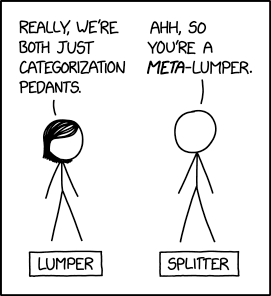
    In the realm of notation of extended techniques, the phenomenon of Lumpers and Splitters is alive and well. First, a short explanation of this phenomenon, then I will give you my take on how lumpers and lumping seems to be the dominant force behind recent notation trends. In Part 2 I will discuss where I think lumping makes sense, and where it doesn’t.

    The first known use of this term is attributed to Charles Darwin, and is defined by Wikipedia as “opposing factions in any discipline that has to place individual examples into rigorously defined categories.” Continuing with the Wikipedia definition, a “lumper” is a person who assigns examples broadly, assuming that differences are not as important as signature similarities. A “splitter” is one who makes precise definitions, and creates new categories to classify samples that differ in key ways.” I first came across this term while reading about the findings of hominin fossils in East Africa. Do the collections of fossils represent one species, or several? A lumper would say one species, a splitter would say many.

    In fields where there is only a very small sample size, or there is little objective, material criteria, such as (historical) linguistics, religion, software engineering, you will find these discussions. Among musicologists, there are lumpers and splitters who debate on the periodization of our (Western) musical history.

    I am seeing a definite tendency towards lumping in the notation of extended techniques: using the term jet whistle to refer to diverse air/aeolian sounds, referring to multiphonics as split tones (no pun intended!), or all sorts of pizzicati referred to as slaps.

    As to why there is this trend, “splits can be lumped more easily than lumps can be split” is perhaps the simplest explanation. And we all know that the more information that is out there, the less overview there is, and fewer people will take the time to try to navigate it. Therefore, the lowest common denominator prevails.

    In my practice, I think it makes sense to lump some techniques, whereas other techniques could be more effective if they were subject to more differentiation.

    More about that in Part 2.


  • Multiphonics: Tips for Study

    Actually, this is a “notes-to-self” entry disguised as “Tips”. There are good sources for learning and practicing multiphonics such as Robert Dick’s “Tone Development through Extended Techniques” (although I know the term “extended techniques” has gone out of fashion, but the practice in the book is solid). I also have a detailed presentation where I approach learning multiphonics through the study of flute harmonics and spectral hearing. If you know of any other learning materials, please share them in the comments.

    Now to the notes-to-self. It is well and good enough just to learn and practice multiphonics, but time has shown that one is often asked to perform multiphonics under less-than-ideal conditions. This goes especially for ensemble pieces when there are others playing, and it is difficult to get aural feedback from your own playing in order to make the minute adjustments necessary to play a multiphonic. However, in solo works there are also challenges, where a multiphonic might be difficult to approach in context (in a series of them, or after a particularly tiring passage, for example). So how do I prepare for that? Part of the answer is simply training in-context, as well as the reassurance that experience will bring. At times it is helpful to ask yourself, or the composer, conductor, or chamber-music colleagues which note in the multiphonic is of most importance? What voice should I bring out? Perhaps most important of all: can I find a better fingering?

    And sometimes the composer thinks that he/she is helping by saying “oh that’s ok, I want an unstable sound, you can vacillate between the notes”. OK. That is something that has to be practiced too, because often a vacillation comes with a sudden jump in dynamic. In most cases, this is not the effect the composer is going for. This led me to a practice that I think is very helpful for close multiphonics such as this one (taken here in context from Joseph Lake’s Concerto for Prepared Piano):

    I should emphasize that the basic way to approach a multiphonic is to take it apart, get to know the dynamic range of all the notes, do the throat tuning to the weakest, etc. etc. These steps have been covered in tutorials by myself and others. But once this has been done, we often get caught up in trying to get both notes equally, and then still failing. In past tutorials, I talk about using fluttertongue to help find the position of the tongue that will work, and listening and aiming for the difference tone or beatings of the notes rather than the two notes themselves (logically, aiming for one thing is easier than aiming for two, right?). Another trick to throw out is to practice this vacillation that composers are so fond of – slowly. If you can control going between the notes slowly, and minimize the jump in dynamics that sometimes accompany the movement, I find that the actual multiphonic sounds more than you expect.

    So those are my thoughts from today’s practice, if you have anything to add I would be curious to know.

  • Sixth-Tone Exercise Audio

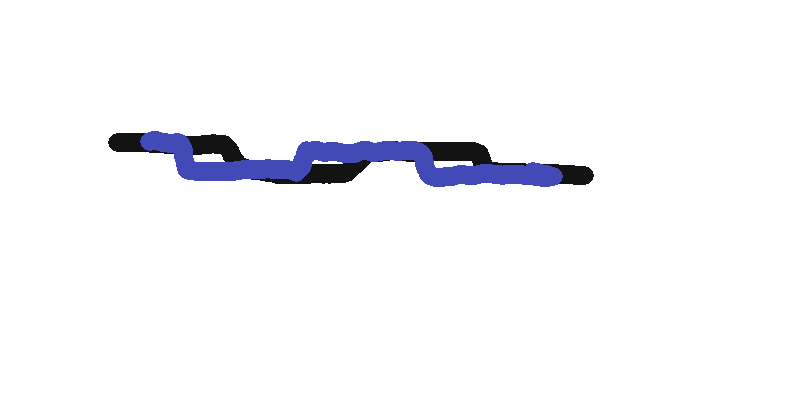
    This is a very simple exercise for playing sixth-tones The audio file has undulations on three notes: (I picked these because they appear in a piece I am coaching.)

    • Bb3 – Bb3 sixth-tone lower
    • Db4 – Db4 sixth-tone lower
    • C3 – C3 sixth-tone higher

    All you have to do is practice at first playing with the undulations, then against them so when the audio plays Bb – you try to play Bb sixth-tone lower, and check yourself as the tone moves. Here is a crude display, you can imagine the audio as the black line, your sound as the blue line.

    Tuning is A=441

    Here is the audio file

  • What is your Superpower?

    Having a kid and playing modern board games where it is teamwork against the forces of chance or evil (not everyone for him/herself like in my day), it is easy to fall into this kind of thinking.

    Because these days, everyone is special, right? No one is supposed to get left behind. Everybody has their own, special superpower. So what is my, personal, superpower? I am hoping I don’t have just one. However, for the time being, since I am spending a good amount of time each day on the piccolo, it is easy to imagine my superpower is that of playing high B’s and C’s. This is my special weapon, to produce blasts that measure over 100 decibels. Do I use it to combat evil? Well, maybe in my imagination only. But since this is not a game, it is my actual job to produce these notes, I have to deal with the situation in my own way. If I delude myself in order to produce what a composer writes, well, we all have to do whatever it takes, right?

    The thing with superpowers is that they do not happen automatically, you have to train them, refine them and learn to engage them exactly when needed. ZAAP!! Bullseye!

    In “The Dong with a Luminous Nose” by Georges Aperghis, on page 18 (of 21), after playing loads of low, airy sounds, singing and speaking, there are suddenly a few high C’s that pop up. And to boot, the piece ends on a high C. Now, high C’s are supposed to be my superpower, but they often fail me here in this context. Among the Jumbly Girls, the wail of the chimp and snipe, I forget that I have a lethal weapon in my hands. So my practice has to involve a lot of psychology. I have to remember to engage this power, to never lose sight of it. For this, microseconds help. Taking that microsecond in the leap to high C from the D below, not to say “Oh $§&”*”, but to say “Engage!” This takes practice (for me).

    So I share this so you all can think about your own superpowers, hone them, and practice engaging them. See if it works for you.

  • The Dong

    I have been meaning to keep an online account of my adventures with Georges Aperghis’ piccolo solo “The Dong with a Luminous Nose”, but it’s already three weeks before the performance and I haven’t written much. There are practical reasons for this – one is we ironed out the final version with cuts and tempo changes a few days ago. Only now do I have a sense of the piece as a whole and feel that I can do the real work.

    Since he has heard and approved my recent draft recording, only now am I confident that my strategy for playing all the quarter tones, the types of vocalizations and interpretation of timings are ok. I find it really difficult to invest in the technical details of a piece unless I know the overall musical and compositional approach, because only by knowing this, do I know how to technically approach the piece.

    Although I have heard and performed a number of Aperghis’ pieces before, the ARTE documentary from 2006 “the composer who reinvented musical theatre” gave me more insight.* Here is a quote that I like:

    “…observing a performer in their day-to-day life, during rehearsals, over coffee, in their usual behavior, one sees their inner charm and from that point on, writing for them, to my mind, means believing them to be much stronger than they are, musically, I mean. So often, when the score arrives, they are happy yet anxious due to its difficulty. Because I feel they are capable of it, that’s the fault of love. I feel they can do anything, and they can, because they do, but at a price. “

    Aperghis and I got to know each other personally while he was preparing to compose Intermezzi for Ensemble Musikfabrik. In our conversations, I mentioned that I enjoyed the nonsense texts of Edward Lear. “The Dong” is a text by Lear (his choice), and to my knowledge, this is the only work of Aperghis that really has a narrative. His other works seem much more abstract and cathartic.

    I have also been thinking about music and text. A lot of text that goes into music these days is political or makes some kind of statement. Although I support this wave of awareness and wokeness, I still think there is a place for words in music as phonetic material with artistic, or dare I say it, entertainment value. If the text of this piece included the words “damn the patriarchy” or “Frauenpower forever” it would perhaps make me feel better about myself, giving me that warm, fuzzy feeling you get with acts of solidarity and “doing one’s bit”. But in the end, what bit is that? My performance would change no one’s social perspective. (And in Darmstadt, where the premiere is to be held, I would be preaching to the choir.) My bit would be better played out by volunteering in a homeless or refugee shelter, or helping people safely vote. This is not to say I don’t believe that certain forms of art are capable of promoting and instigating social change.

    So I will perform and narrate Edward Lear’s text, with all its humor, overtly phallic symbolism** and allusions to interracial love. Why not? I might even perform it from the perspective of a Jumbly Girl.

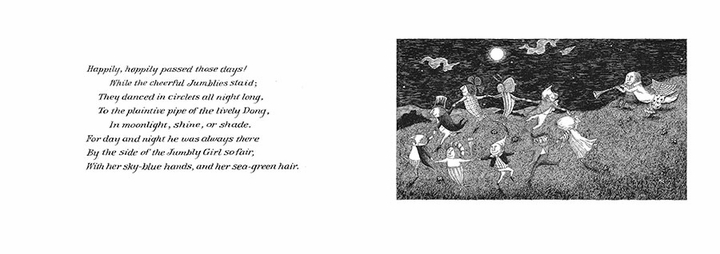
    Illustration by Edward Gorey

    *I would share the link, but my automatic embedder is giving me grief.

    **Ok maybe my mind is in the gutter.