In preparation for many projects this year, including Picture a Day by George Benjamin, Cortège by Harrison Birtwistle, and coaching Tutuguri by Wolfgang Rihm, I extended Peter-Lukas Graf’s register exercise from his Check-Up for Flute.
Finally it is cleaned up and I can link to a shareable verson 🙂
Advice on how to prepare the microtonal, spectral works for large ensemble and orchestra of Georg Friedrich Haas and other spectral composers.
These remarks are a culmination of my years of experience playing spectral works and coaching the academists at the Grafenegg Festival 2026 for the premiere of Hyena II for Orchestra and Storyteller under the direction of Ilan Volkov. (See also important changes to the first flute part towards the end.)
Figuring it all out:
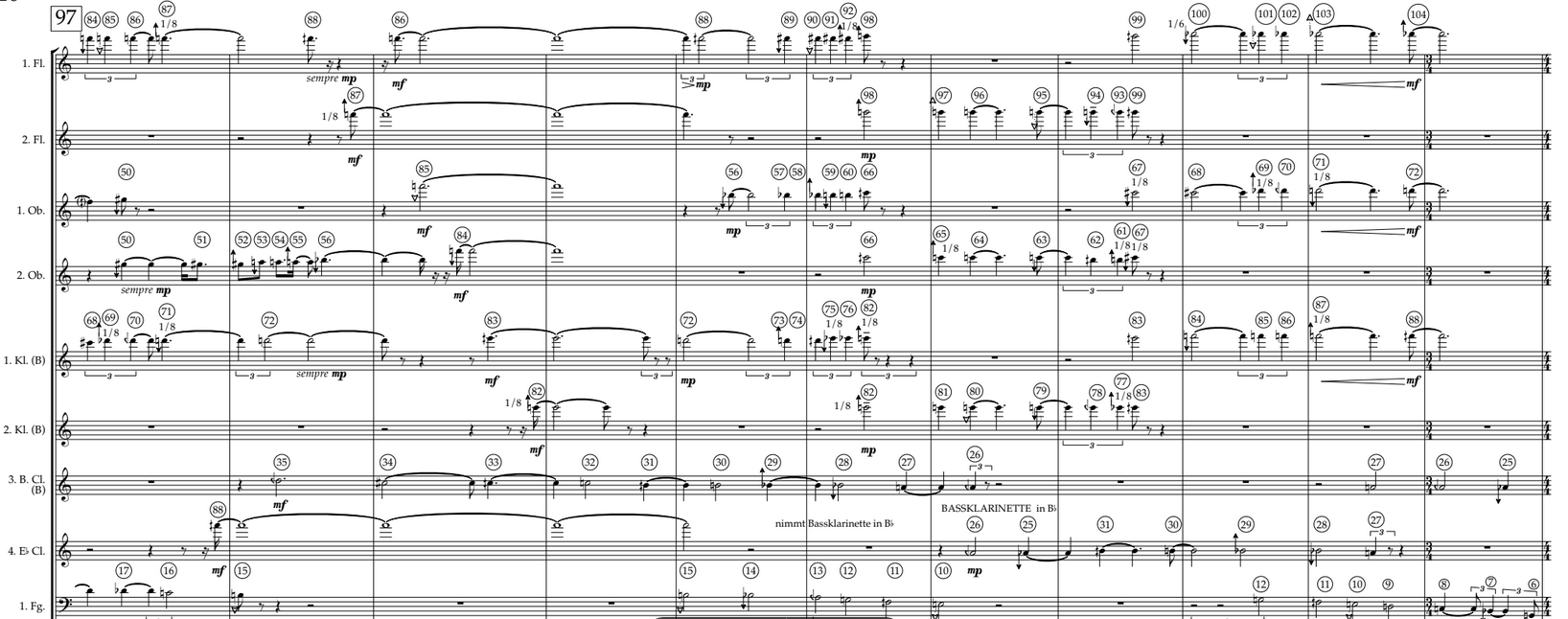
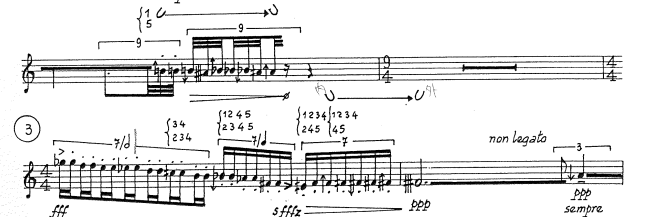
This is an example of the notation we were faced with:
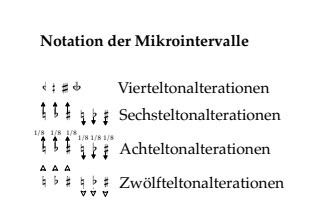
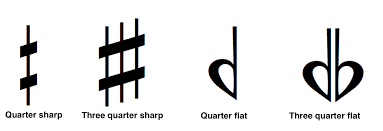
Haas was very considerate in providing the following approximate accidentals:
Translation: Notation of Microintervals:
Quarter-tones, sixth-tones, eighth-tones, and twelfth-tones respectively
Using these accidentals is a practical strategy for large orchestras. The indications allow players not familiar with spectral music to rely on their instincts to at least approximate the pitch. However, the circled numbers above the notes indicate the partial number and therefore the true pitch.
These partial numbers represent a position in an overtone (harmonic) series based (in this piece) on C0. Here I use the terms harmonics, overtones and partials interchangeably, although there are some subtle differences. Note that because this is a mathematical series that starts with 1 (not 0), the 1st partial IS the fundamental.
So the first thing you need to know for playing a harmonic series is: what is the fundamental? The score says only ca. 16 hz as an indication, because this will change according to what your group tunes to – A=440 or higher.
Once you know that fundamental, you “only” have to multiply that number by the circled number above your note. That gives you your frequency. However, for many musicians, it is easier to think in terms of cent deviations, where the half step is forther divided into 100 equal steps. Modern tuning apps give us cent indications, so they have become a way many of us think when it comes to being sharp or flat.
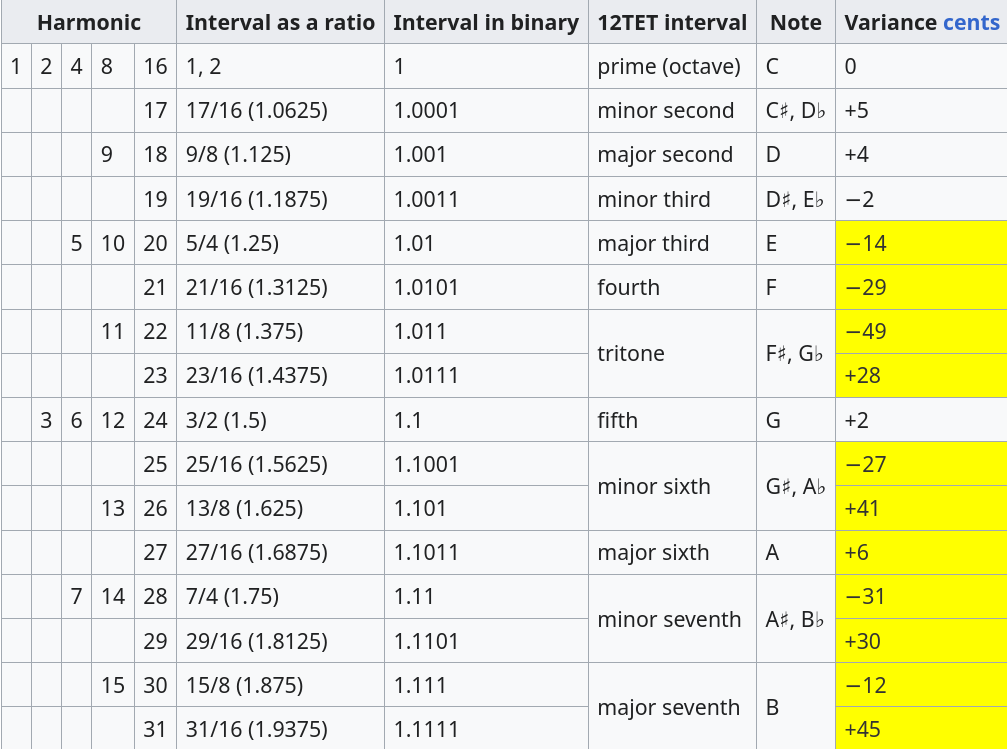
I can understand a composer not wanting to put a cent deviation above each note of an orchestral score, that would indeed be messy. But it would have been practical to have this chart from Wikipedia, for example, in the performance instructions:
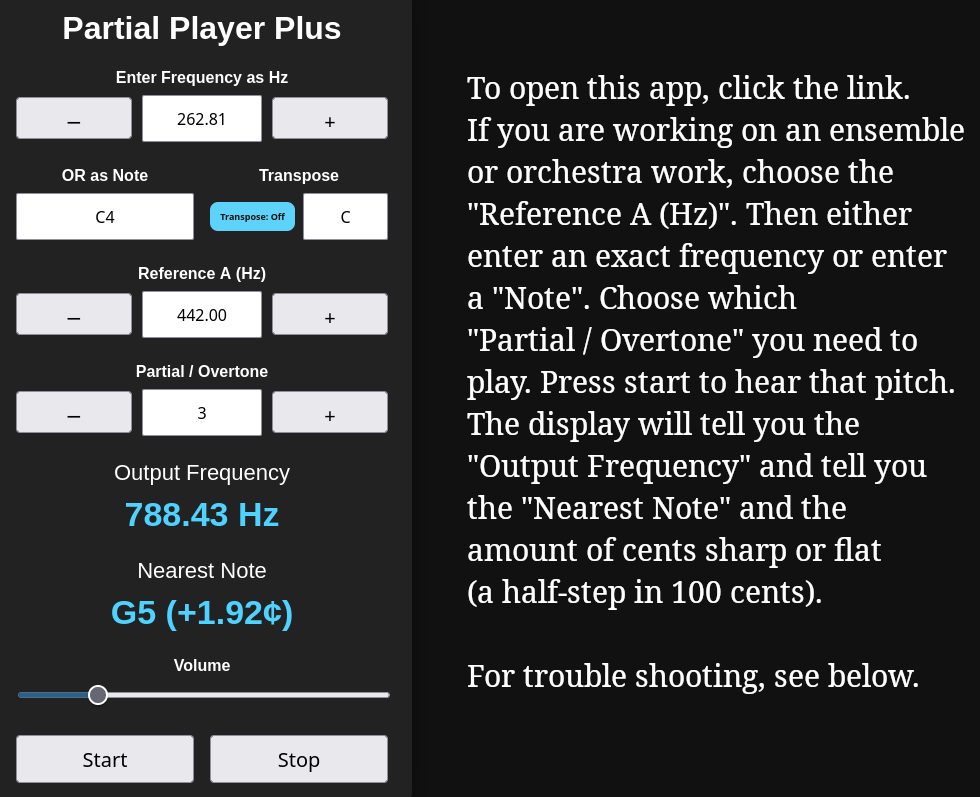
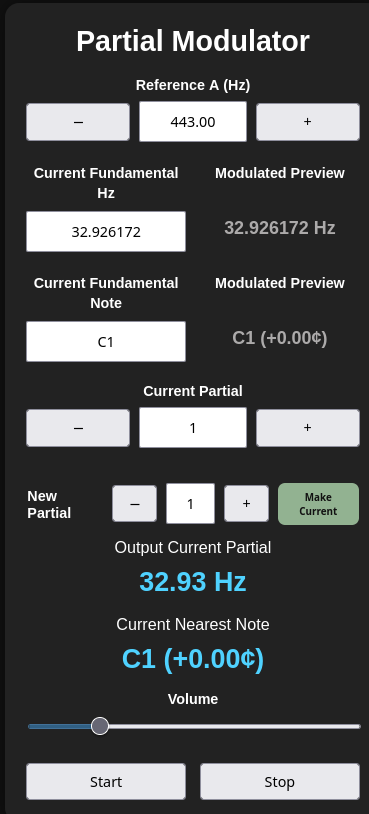
In order to make all this easier, to calculate the partials above 31, and to have a quick alternative to view these notes according to cent deviations, I created this app:
Note that the transpose feature will only change the “Nearest Note” display!
Troubleshooting for Partial Plus app:
– Make sure JavaScript is enabled on your browser (see your browser settings).
– Low frequencies need a lot of volume boost,
– If your ringtone is muted, this may mute the sound of the app too. For iPhone, there is a small button on the side of the phone, on the upper left.
– If you have an old phone (iPhone 11, for example) it just may not work. Use an iPad instead (or laptop).
Knowing what frequencies to play and what fingerings to use is only part of the work. There are two other important factors: listening and sound quality.
Listening:
Despite the mathematics involved, this work, and many other spectral works, involves listening, being able to hear and predict your pitch from either the fundamental or the fifth (which you can hopefully hear or remember).
With the app (or any listening aid), I recommend listening up to the first 16 partials. If you want to challenge yourself to a new scale exercise, learn the partials 8 – 16 in all keys. (It’s kind of a whole-tone bebop scale :)) I am developing other exercises for listening, recognizing, and playing partials, so stay tuned.
To become confident in this piece, you really need to hear up to the 13th partial. If the instrument playing the fundamental is sharp or flat, you may not be able to rely only on a fingering you learned, you have to be able to adjust in real-time using your ears. Remember, if you have to play the 2nd, 4th, 8th, or 16th partial, that is just an octave relationship to the fundamental. If you have the 3rd, 6th or 12th, that is a perfect fifth relationship. If you don’t get that right, the other players who have to play the partials of a 5th, 7th, 9th, or above will have trouble.
The very high partials can (at least in Hyena II, say, above 37) be relativized. That is, there is often a play between players, In the passage below, for example, the flutes, oboes and clarinets enter on pitches where each is slightly lower than the other. Tricky, yes! But doable by ear with practice.
Modulations:
Sometimes, especially in the works of Haas, the fundamental will modulate. This is a real challenge for the lower instruments, because sometimes their fundamental falls off the equal-temperament grid. In Hyena II, there is a chain of modulations where the 9th partial becomes the 7th partial of a new spectrum. For this I made the another modulator app. The instructions are pretty much identical to the one above, but you can choose a new partial, preview the modulated fundamental, then push “Make Current” establish it as the current partial system.
Sound Quality:
Despite this being contemporary music, in an orchestral or large ensemble context, spectral music is often most effective with a “nice” classical sound. That is, not too unfocused or airy. You have to produce a sound that others can easily hear and tune to. The sound has to have enough partials in it to be interesting and to mix with the partials of other players – no matter what dynamic.
This is important to know when choosing fingerings. In our first session with the flutes, we were considering using some rather bamboo-sounding fingerings involving the trill keys. These didn’t really work in context. In addition, one also has to take into account the speed and dynamics as well as the sound color when choosing fingerings.
Important changes in the first flute part:
Bars 722 – 731, and 856 should be played on piccolo (sounding as written, the piccolo fingering an octave below).
This text has been adapted from introductions to my presentation to student composers on writing for flute that I have given the last few years. The actual presentation is here.
I’d like to start with a short preface about some general ideas not specific to the flute, and to preface: what I am about to say you can easily ignore if you are writing a solo piece for a particular player. But to successfully work as a composer with an ensemble or orchestra filled with professional, experienced, perhaps middle-aged and grumpy players, I suggest you pay attention.
I have reservations about giving these kinds of information-dump talks these days. You don’t really need me here, most of this stuff you can find on YouTube. However, information is not knowledge, and as a teacher I want to impart and share knowledge. That is why I will try to focus on concepts, because as adult learners, that is what we really retain.
Maybe you have heard us players complain that “instrumentation has become a lost art”. I used to think that, but now I think that is somehow romanticized. Perhaps what we are observing is the nature of evolving systems. As in other systems, such as computer programming and software development, some aspects of the work flow become trivial. In the scope of musical composition, instrumentation has become trivial.
Let me explain. In our society, and in your degree program, you are under pressure to get started and produce right away. So it is expedient to know what knowledge is trivial and what is not. What is not trivial is fundamental; an example of that is the need to know which clef for which instruments, which transposition for which instrument. Just as when learning a computer language quickly, you first learn to print “hello world!” and you need to know how to type the syntax and whether to put a comma, semicolon or whatever at the end of your statements. But beyond that, more specific things (like the code for a fluid dynamic simulation or a how to notate a string or woodwind harmonic) can be looked up and then memorized as it becomes part of your routine. In other words, you don’t have to carry around tons of information in order to get started and get productive. This is what I mean by an evolved system, they tend to have streamlined and rapid work flows. Whether it is a short-lived or long-lived system remains to be seen.
So as I give this presentation, think about what might be fundamental or trivial for you. I will try to underline basic concepts (like acoustical constraints, which you can see from the design of the flute) that I hope you will, if not at least retain, at least remember that this is something you need to check the docs before diving into 🙂 And I will send the link to this presentation for your reference.
In this presentation, I will also try to walk the line of what is necessary for players to read and what will not stifle your creativity. Most of us here at Musikfabrik also do not want to contribute to the culture that is only going to produce sight-readable, boring pieces. At the same time, I want to keep you from making the same mistakes over and over that make players loose faith in your process. If you think about it, would you take a text seriously if it were filled with spelling and punctuation mistakes? That might be acceptable in poetry, if done deliberately for artistic effect. But for that, I would suggest a graphic score 🙂
Speaking of scores, as a final note, I would like to introduce a novel concept that I think should be adopted by all composers, and that is to put your scores (maybe) and parts (definitely) in some sort of GIT version control system. Not only would it be helpful to keep track of different versions, but would also allow community contributions, corrections, improvements, etc. For instrumental parts this would be super! For example, I could suggest fingerings, and that version would automatically be saved for the next player, who might alter them and create their own version, and future players could examine both versions and contribute or correct to make their own. Nothing is erased or thrown away, and the process can be viewed at all stages.
Producing artworks is often teamwork, creativity takes all kinds of knowledge and contributions. No longer are you as composers expected to be lone geniuses who toil in solitary towers, so there should be no shame in allowing players to access your parts and make them playable in their own way and then share them back to the community. This would put publishing houses in trouble, though.
To get started before doing the exercises specifically for piccolo, have a look at this exercise on page 5 from this collection of harmonics exercises (sorry the pages are not numbered). For some reason, I find them especially beneficial for piccolo. It’s good for developing awareness of exactly what combination of physical actions you need for going high – abdominal support, embouchure, placement of the tongue and jaw, and notice how the throat sometimes tries to help. Very kind of it, but not necessary 🙂
This preliminary harmonics exercise will help with the challenges found in these two piccolo warmups which I have developed over the years. The first is meant to be quite slow, ideally to be played with a drone / tuner on the fundamental. The second is of course a rip-off of TG EG no. 1 and Mozart, but it works esp. for articulation and agility with large intervals. It’s kind of a killer when you go high, so take it easy if you are new to the piccolo.
Composers often write for the piccolo not only because of its high frequencies, but because of its agility. That requires strength and training, and smart body awareness in order to avoid injuries or strains. Also, please protect your ears while practicing! If you don’t have professional earplugs, I find the silicone ones (also used for swimmers) quite good, you don’t even have to stick them inside your outer ear canal, just a little bit to cover the opening of the right ear is sometimes enough for me.
Since the 1967 publication of Bruno Bartolozzi’s New Sounds for Woodwind, there have been many books published for new sounds, or extended techniques, for the individual woodwind instruments. (Read here about some thoughts about the term “extended techniques”.) However, to my knowledge, since then, there has been no book that addresses the emerging uses of extended sounds for the woodwinds as a whole. This has become a problem for composers whose main focus is orchestral and ensemble writing.
I do not intend to disparage the hard work that has gone into the existing books for single instrumental techniques (for example, the Bärenreiter series). However, reading each individual book is not entirely helpful (or cheap) for a composer who wants to write an orchestral score with these techniques – a score that graphically reflects the Geist of the sounds (open note heads for air sounds, for example) and is consistent in its notation throughout the staves. These aspects are very important for juries, funding committees, conductors, and other people whose job it is to peruse scores. Then there are the players, for whom the score also needs to give clear information as to what to play and how to play it.
Take air (aeolian) sounds, for example. It’s a very different production technique for flute, single reed, or double reed, and they produce different sound results. However, a composer will want a unified notation and a conductor will expect a balanced sound from this notation (which usually doesn’t result!). A similar situation with percussive techniques. Different methods of production are even reflected in our terminology (slap tongue for reeds, pizzicato for flutes). And unpitched material? Ideally a composer might want to reflect it by a clef change (using a precussion clef), but for winds, often our “unpitchted” material needs a fingering, therefore five lines and a treble or bass clef (think tongue ram or jet whistle).
In spite of my love for continuing the flute traditions of notation, and my pedantic writings on “Lumping and Splitting” notations, I do agree that some things could be improved by re-thinking the notational traditions that came out of solo works that flourished in the 1980’s and 1990’s in order to make a more comprehensive, woodwind-wide system that makes a composer’s life easier. Any thoughts?
Please understand that for all winds, we have to use special fingerings or lip adjustments for microtonal playing. This can make fast passages tricky, and not just twice as tricky, but I would even say to a factor between 5 and 10 times as hard. My first advice is to avoid fast passages, but there are ways under which quick microtonal passages can work, so here are some guidelines:
In short, if you have to go fast:
avoid notes that need to be lipped, or need to have the flutist roll the flute in or out (i.e. notes that have no fingerings): G-1/4 flat (F-3/4 sharp) and all the notes below our low Eb (anything produced by the foot joint, where there are no open holes), unless all notes in the passage can be lipped in the same direction (all 1/4 or 3/4 sharps, for example).
if you are considering such a lipped passage, don’t mix 12ET (chromatic) and microtones together. If we have to lip, it’s nice if we can keep our lips in the same direction for an ergonomic length of time and not have to “reset” to normal for a single note in a fast passage.
whether lipped or fingered, keep the motion scalar, larger intervals can be trickier esp. over a break
keep the passage short or discontinuous
These remarks are for standard, open-hole systems, but those of us with a Kingma system will also be grateful if you follow these guidelines. Be aware that closed-hole systems (and this includes most piccolos, alto- and bass flutes) have even more limitations when it comes to playing fast.
As usual, my remarks are geared heavily towards ensemble works, which are often delivered late and may not have enough rehearsal time. In writing a solo piece, whatever two consenting adults agree on is ok.
What do I consider fast for microtones? Subjectively, 16ths above quarter note = 100, or any speed where rolling in and out (another term for lipping) quickly is not feasible. Often fingerings work, but sometimes notes need to be lipped (like that pesky G-1/4 flat). There is also the question of how long a microtonal passage is – if faster but short with a few microtones, that can be ok.
What about Xi by Stockhausen? Why does this work, for a closed-hole flute no less? First of all, the motion is scalar, which makes it easier. Second of all, he had an awesome flutist collaborator to guide him: Kathinka Pasveer. Another aspect is this is a solo piece, it is understood that hours of preparation are going to be invested.
Here are some examples from Grisey and Aperghis:
The above example works because of the scalar motion, and the dreaded F 3/4 sharp is a long note that can be lipped.
The above example here breaks some of my guidelines, but is doable, and as long as the passage is short it’s fine for me. However, unless you are already a famous composer, I would still advise you to think more closely about a passage like this and perhaps make some ergonomic adjustments, especially if it’s not a solo work and the passage becomes extended.
Should you write in the fingerings for the flutist? Nowadays (2025), most professional players will know the standard quarter-tone fingerings, or they have access to charts. However, if you want a shaded microtone with a special sound associated with a special fingering, yes, please provide it.
As a general rule, it’s nice for the player to know what role microtones play in your work. Do you use quarter-tones as a part of 24 note equal temperament? Are they sometimes meant to represent smaller, perhaps spectral intervals? Do they reflect the inflections of speech or some other acoustic phenomenon?
Here are some general remarks on notating microtones, taken from Ensemble Musikfabrik’s Style Guide. Accidentals: For equal tempered quarter tones:
Smaller intervals may be indicated with arrows or other symbols, but must be clearly labeled in the performance instructions. Spectral and just intonation: we recommend the additional use of ratios, partial numbers or cent indications. Apply quarter-tone accidentals only for the 11th partial.
With two performances behind me, I thought I would jot down a few notes on A Pierre. Dell’azzurro silenzio, inquietum by Luigi Nono. This is a “notes to self” for my future performances, but I hope they shed some light on some questions for other performers as well. These comments pertain primarily to the flute part.
I won’t go into the background of the piece, instead, I will direct you to Daniel Agi’s helpful article and table of multiphonics for performing this work on a C bass flute. Here is a share version of the full article. I also recommend reading the “Notes on the text” by André Richard and Marco Mazzolini found in the score. Another interesting read is an article by Laura Zattra et al “Studying Luigi Nono’s A Pierre“.
Nono portrait concert with Musikfabrik Sept. 2024
The part of the score that elicits the most questions for flutists is the indication for whistling (fischio). Roberto Fabricciani, Nono’s flutist collaborator in this work, whistles through his teeth; this is the method that can best combine whistle sounds and the resonance of the flute. I would prefer whistling this way if I could. Despite my efforts, I can’t reliably control the pitch with this way. Since the score indicates exact pitches (although the octaves can be adjusted to your whistle range), I whistle through the lips.
It’s important to know that the notation can be misleading in that it shows long, held sounds. However, the “Notes on the text”, found in the score, make it clear that every note should actually be in flux: multiphonics need not be entirely stable, fischio sections should fluctuate between the flute sound and the whistles (except where specifically noted that the whistle should be held out). This is also confirmed by a conversation with clarinetist Ernesto Molinari, who appears on the SWR recording with Fabricciani. The transitions from flute sound to whistling are very important. This is in no way reflected in the notation, but it is very important. Do not think that you need to learn a special technique of playing and whistling at the same time. It’s nice if you can keep the resonance of the flute while whistling, but it is the the transitions, the in- between sounds, that are most important.
If you know Nono’s Das Atmende Klarsein, you will be familiar with the technique of whistling and playing with the resonance of the flute. In my opinion, this is a different use of the effect from what Nono wants in A Pierre. In Das Atmende Klarsein, there are melodic and harmonic considerations that argue for the whistling and the flute resonance to be as steady and balanced as possible, whereas in A Pierre, they should be elegantly unsteady.
It has now become quite common to play A Pierre on a bass flute in C. There is no published score for this instrumentation; one has to take the original and make the transposition. At some point though, I want to try this piece on the instrument for which it was conceived, a narrow-bored contrabass flute in G. (There are very few of them in existence. See Daniel Agi’s article linked above). My suspicion is that this instrument produces fewer higher partials than modern bass flutes in C, which often have embouchure holes with high walls and a sharp blowing edge so that they can project in ensemble situations. These high partials are taken up by the electronics, especially the band-pass filters, and amplified. I don’t think this sounds terrible, but I wonder if Nono had used these modern instruments in his experiments, he might have chosen different parameters for the filter’s cut-off frequencies and different transpositions for the harmonizers?
Ernesto Molinari also said that the original idea is to have the players seated, not standing. I seem to have a vague recollection of a photo from the original performance with the players seated on stools that looked like contrabass stools. He also said the work should not go on for too long, never more than 10 minutes. For me personally, I think feels correct: this work is a small puzzle of a present for Pierre Boulez, almost jewel-like, and not a zoned-out, meditative work, despite its trippy, hallucinogenic sound world.
Also, keeping to the original timing (without being metronomically, robotically strict) does create a proper coinciding of the delay lines with the fermatas. According to Juan Parra, with whom we performed the electronics – theoretically, during the fermatas, Nono has calculated an event in the past that should be heard in the delay during the fermata. The fermatas are there not only as points of meeting for the players, but for the electronics to play out their parts as well. This is why they are given specific durations. The delay lines are also specifically chosen at 12 and 2 x 12 (24) seconds long for important psychoacoustic reasons. According to experiments Nono and his team did in the electronic studio, twenty-four seconds is approximately the time in which most people do not hear a musically repeated idea as a repetition, but as an independent idea.
I hope this is helpful to anyone working on this piece, including my future self 🙂
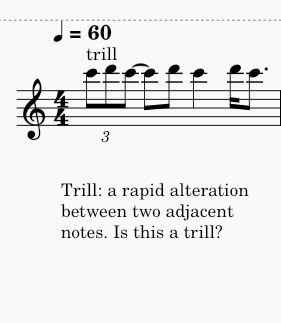
I assume the answer is “no” – at tempo = 60 this is not really rapid.
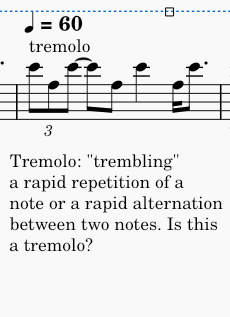
Again my guess is “no”, neither the notation nor the tempo would qualify this as a tremolo.
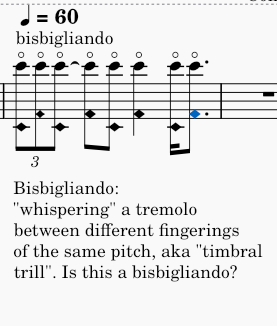
Again the logical conclusion is “no”. It does not fit the criteria for a tremolo or a trill.
So why do we sometimes encounter this notation shown above? Slow-moving harmonic changes are in no way a tremolo, trembling, or whispering, therefore, not bisbigliando. So I would genuinely love to know why this notation above persists; why is the term “bisbigliando” written sometimes over slow harmonic changes? Why does this continue to be taught, where does this tradition come from, and what kind of logic it is based on?
Please, convince me!
Here are some reasons why this notation is problematic. In essence, this is a term for harp players. A little appropriation among musical terms is fine, but I think this extrapolation meaning “any movement between harmonics regardless of context” is misleading. Sometimes a passage can be played with a change in harmonics AND bisbigliando/timbre trill, therefore it makes more sense to be specific. Do you want the slow change of harmonics? Do you want a timbral trill? Do you want both?
So if you don’t really want a timbral trill, what would you write in the passage shown above? The good news is: nothing! You don’t need a descriptive word or any notational elaborations, because the notation speaks for itself. If you want a descriptive word, perhaps use “sotto voce”, “lontano”, “quasi niente” or something to that effect, if it is something atmospheric you are after.