Category: spectralism

  • Spectral fun with Hyena

    Advice on how to prepare the microtonal, spectral works for large ensemble and orchestra of Georg Friedrich Haas and other spectral composers.

    These remarks are a culmination of my years of experience playing spectral works and coaching the academists at the Grafenegg Festival 2026 for the premiere of Hyena II for Orchestra and Storyteller under the direction of Ilan Volkov. (See also important changes to the first flute part towards the end.)

    Figuring it all out:

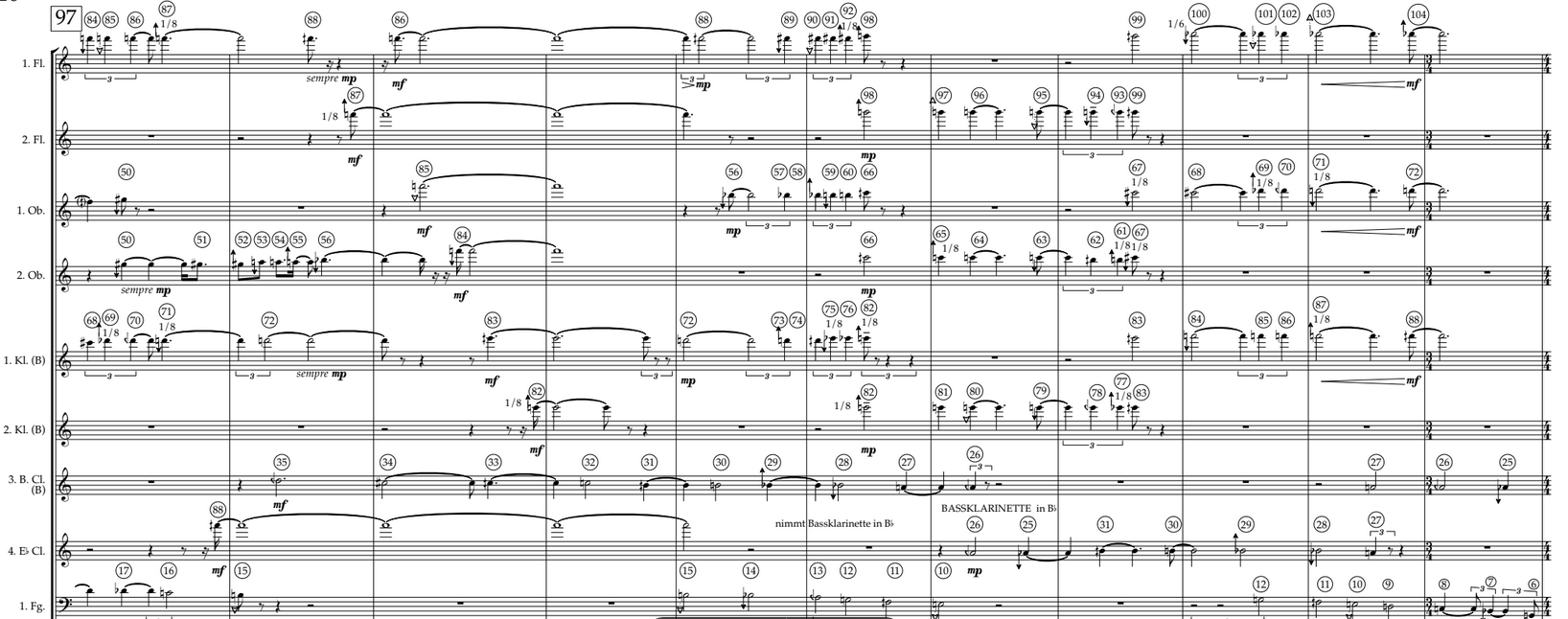
    This is an example of the notation we were faced with:
    Haas was very considerate in providing the following approximate accidentals:
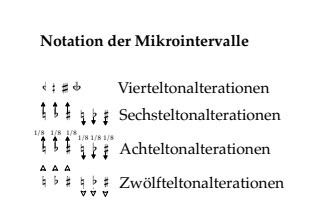
    Translation: Notation of Microintervals:

    Quarter-tones, sixth-tones, eighth-tones, and twelfth-tones respectively

    Using these accidentals is a practical strategy for large orchestras. The indications allow players not familiar with spectral music to rely on their instincts to at least approximate the pitch. However, the circled numbers above the notes indicate the partial number and therefore the true pitch.

    These partial numbers represent a position in an overtone (harmonic) series based (in this piece) on C0. Here I use the terms harmonics, overtones and partials interchangeably, although there are some subtle differences. Note that because this is a mathematical series that starts with 1 (not 0), the 1st partial IS the fundamental.

    So the first thing you need to know for playing a harmonic series is: what is the fundamental? The score says only ca. 16 hz as an indication, because this will change according to what your group tunes to – A=440 or higher.

    Once you know that fundamental, you “only” have to multiply that number by the circled number above your note. That gives you your frequency. However, for many musicians, it is easier to think in terms of cent deviations, where the half step is forther divided into 100 equal steps. Modern tuning apps give us cent indications, so they have become a way many of us think when it comes to being sharp or flat.

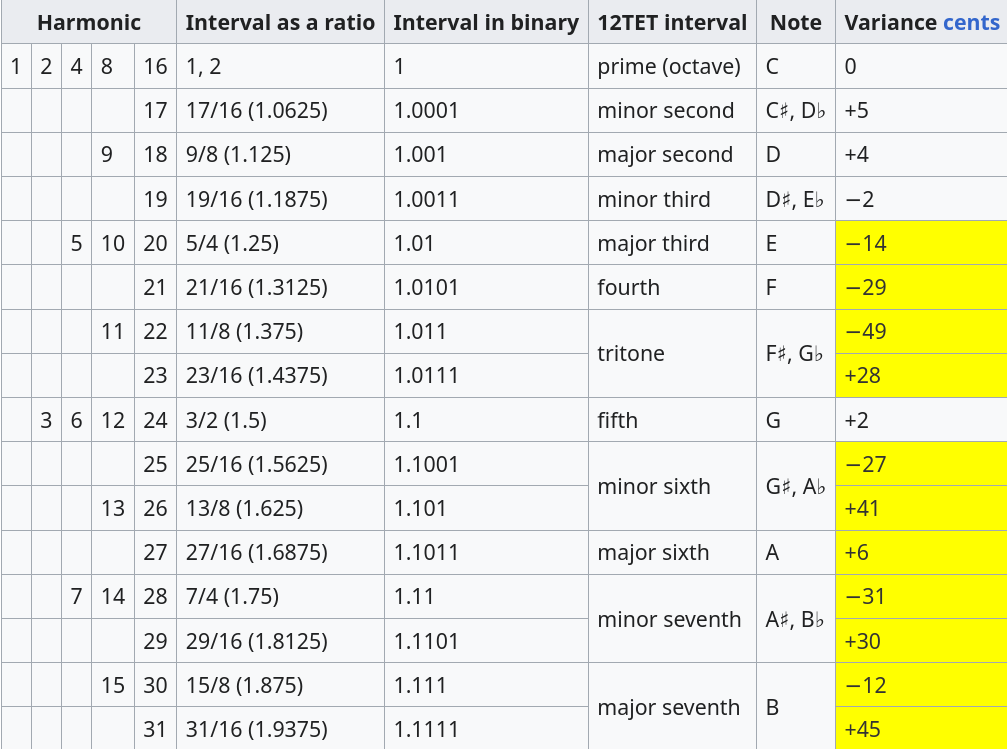
    I can understand a composer not wanting to put a cent deviation above each note of an orchestral score, that would indeed be messy. But it would have been practical to have this chart from Wikipedia, for example, in the performance instructions:
    In order to make all this easier, to calculate the partials above 31, and to have a quick alternative to view these notes according to cent deviations, I created this app:

    Here is the link
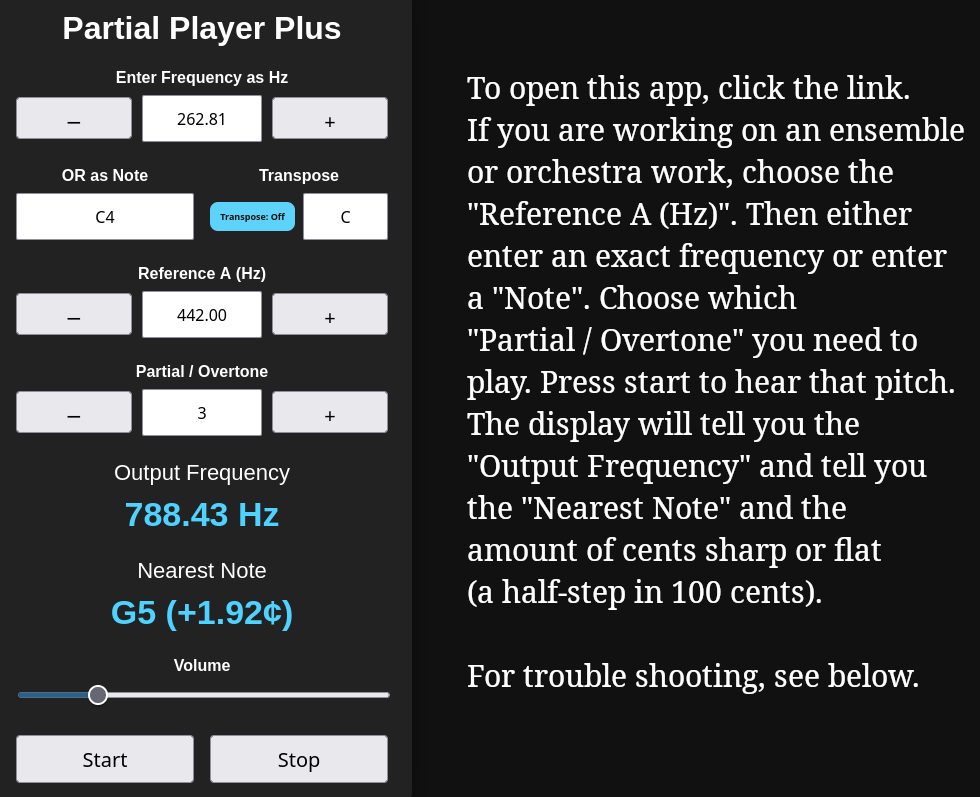
    Note that the transpose feature will only change the “Nearest Note” display!

    Troubleshooting for Partial Plus app:

    • – Make sure JavaScript is enabled on your browser (see your browser settings).
    • – Low frequencies need a lot of volume boost,
    • – If your ringtone is muted, this may mute the sound of the app too. For iPhone, there is a small button on the side of the phone, on the upper left.
    • – If you have an old phone (iPhone 11, for example) it just may not work. Use an iPad instead (or laptop).

    Knowing what frequencies to play and what fingerings to use is only part of the work. There are two other important factors: listening and sound quality.

    Listening:

    Despite the mathematics involved, this work, and many other spectral works, involves listening, being able to hear and predict your pitch from either the fundamental or the fifth (which you can hopefully hear or remember).

    With the app (or any listening aid), I recommend listening up to the first 16 partials. If you want to challenge yourself to a new scale exercise, learn the partials 8 – 16 in all keys. (It’s kind of a whole-tone bebop scale :)) I am developing other exercises for listening, recognizing, and playing partials, so stay tuned.

    To become confident in this piece, you really need to hear up to the 13th partial. If the instrument playing the fundamental is sharp or flat, you may not be able to rely only on a fingering you learned, you have to be able to adjust in real-time using your ears. Remember, if you have to play the 2nd, 4th, 8th, or 16th partial, that is just an octave relationship to the fundamental. If you have the 3rd, 6th or 12th, that is a perfect fifth relationship. If you don’t get that right, the other players who have to play the partials of a 5th, 7th, 9th, or above will have trouble.

    The very high partials can (at least in Hyena II, say, above 37) be relativized. That is, there is often a play between players, In the passage below, for example, the flutes, oboes and clarinets enter on pitches where each is slightly lower than the other. Tricky, yes! But doable by ear with practice.

    Modulations:

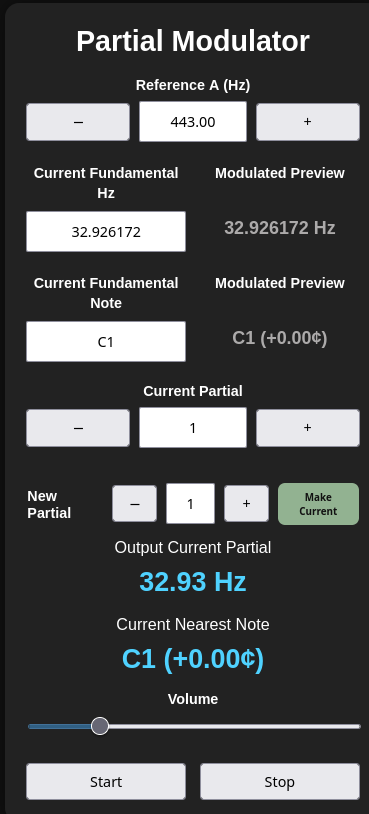
    Sometimes, especially in the works of Haas, the fundamental will modulate. This is a real challenge for the lower instruments, because sometimes their fundamental falls off the equal-temperament grid. In Hyena II, there is a chain of modulations where the 9th partial becomes the 7th partial of a new spectrum. For this I made the another modulator app. The instructions are pretty much identical to the one above, but you can choose a new partial, preview the modulated fundamental, then push “Make Current” establish it as the current partial system.
    Sound Quality:

    Despite this being contemporary music, in an orchestral or large ensemble context, spectral music is often most effective with a “nice” classical sound. That is, not too unfocused or airy. You have to produce a sound that others can easily hear and tune to. The sound has to have enough partials in it to be interesting and to mix with the partials of other players – no matter what dynamic.

    This is important to know when choosing fingerings. In our first session with the flutes, we were considering using some rather bamboo-sounding fingerings involving the trill keys. These didn’t really work in context. In addition, one also has to take into account the speed and dynamics as well as the sound color when choosing fingerings.

    Important changes in the first flute part:

    • Bars 722 – 731, and 856 should be played on piccolo (sounding as written, the piccolo fingering an octave below).
    • Bar 471 F# should be an 1/8th tone up
    • Bar 801 D natural should be a 1/6th tone down
    • Bar 813 F natural should be a 1/6th tone down

  • Microtonality: some basic tips

    Microtonality is the use of intervals smaller than a half-step such as quarter tones, sixth tones, eighth tones and so on.

    There are several standard ways in which microtones are used (which may be interconnected):
    • As part of a “just” intonation scheme (based on pure intervals instead of equal [keyboard] temperment). Used in a simple way (also known as mean-tone tuning), one plays perfectly in tune in a given key, less so in related keys and totally “out there” in remote keys. So far I have come across no better explanation and description for just intonation than David Doty’s Just Intonation Primer. Or click here for an on-line explanation of just intonation.
    • As part of a “spectral” scheme where the notes are not tuned according to equal [keyboard] temperment, but according to the intonation of upper partials of a given overtone sequence. This is related to just intonation (and again David Doty’s book explains this wonderfully), however in a “just”intonation environment there may be a tonality implied, whereas in “spectral” music a tonality is rarely implied (although there may be a tonal center). Here is an example of how the overtone sequence on our low C is naturally (purely) tuned. The deviation from equal temperment is measured in cents. (Cents are measured by dividing an equal tempered half tone into 100 units. These are marked on most tuners to indicate the degree to which one is sharp or flat.)
    ◦ 1st harmonic (fundamental): C (no change)
    ◦ 2nd harmonic C (no change)
    ◦ 3rd harmonic G: (2 cents sharp)
    ◦ 4th harmonic C: (no change)
    ◦ 5th harmonic E: (14 cents flat)
    ◦ 6th harmonic G: (2 cents sharp)
    ◦ 7th harmonic Bb (31 cents flat)
    ◦ 8th harmonic C (no change)
    ◦ 9th harmonic D (4 cents sharp)
    For the deviation up to the 31st harmonic, see Wikipedia’s entry on the Harmonic Spectrum.
    For tips on how to get these partials in tune without having to resort to watching the cent meter on your tuner (i.e. by ear) read my entry on spectralism.

    • Sometimes a composer may invent a tuning system, then it is up to you to determine: a) why/how the composer uses microtones and b) how you should approach them. These questions will help to determine whether or not the composer has included microtones as special “effect”; i.e., should the “de-tuned” notes be given special colors to contrast the “normal” notes, or does the composer want consistency of timbre? This is an important factor in determining fingering (if not already prescribed by the composer).

    Once the interpretive questions have been addressed, there comes the time to actually play them. There are several fingering charts available such as Matts Möller’s quarter-tone chart. They are good resources but think of them as starting points. My personal advice is to know as many fingerings as possible for a particular note. Be flexible in the choice of fingering because there are several factors to consider when making your choice:
    • the speed of the gesture
    • the intervallic relationship to its neighboring notes
    • the dynamic and tone color
    Although each of these is an important consideration, it is crucial to know your end tempo and always have it in mind. I have made the mistake of carefully going through a score and writing in all the “correct” fingerings for microtones, only to have to change them later as I got the piece up to tempo. Practice the notes in tempo, if only two or three at a time to get a feel for this.

    Sometimes the solution can be simpler than you think. Turning the flute in or out to “de-tune” a note can work just as well as a really complicated fingering. For example: on a standard flute there is no stable fingering for F 3/4 sharp. If you need a loud, stable tone just play F# and lip up. If you need a quiet clear tone, finger G and lip down. (Of course if you want that hollow, bamboo sound, use low B and half hole the F-key [index finger right hand].)

    A note on different flute models: I play on a quarter-tone Kingma System (produced by Osten-Brannen). This is a really great system, and I can recommend it for anyone who wants to play a lot of contemporary music. These flutes are also suitable for all repertoire. However, every flute has the capacity to play microtonally (as we all know, sometimes inadvertently!). Please don’t be discouraged from playing the modern repertoire if you have a standard flute, even if you only have a student model with closed holes. There is still repertoire that can be played on student models such as the flute solos by Karlheinz Stockhausen. See my repertoire list for more suggestions.

  • Intonation III : the Spectre of Spectralism

    Some days ago I got the score for G. F. Haas’ new work „ … wie Stille brannte das Licht“. (What is it with German-speaking composers and their titles with elipses?). It got me thinking about how different composers notate microtonality. I like what Haas has done, it is explicit in placing the note within a frame of reference.

    The notated C quarter-sharp in bar 241 is the 11th partial of G, and the A-flat in bar 245 is the 21st partial of E-flat (along with the indication that you are in a perfect fifth with the clarinet). I like having this kind of information in the score, but if he had notated the exact deviation in cents, that would have been even more helpful. This is easy enough to find out in Wiki

    That 11th partial should a C# 49 cents flat, and the 21st partial should be an A-flat 29 cents flat. Like I said, easy enough for find out, but it would have been nice if the composer had provided this information.

    We haven’t had rehearsal yet, so I can’t say how this will sound or how easy this will be to hear. [ed. read my follow up at the bottom of this post]
    So now the question arises: How does one practice this stuff?

    First of all, I get my tuner. Trying the A-flat first, I make sure that our Eb’s are in tune. Then I play an A-flat ca. 29 cents flat. Then I keep that tone while putting the sound on to Eb and I hear a Bb combination tone. This is a clue that I am on the right track, or within the correct overtone spectrum. Your combination tone (it may be a true difference tone or not, depending on the timbre and register of instrument) should lie in close relationship to the fundamental – say an octave, fifth or major third (which is the 5th partial, you don’t want to go much farther than that). Put in simpler terms, it should be part of the major triad formed by the fundamental.

    Now to try the C# against the G. Again I tune the G’s, then test my C3 so the needle goes about 49 cents flat, then put the sound on G. My difference tone is B natural this time, still close enough (a major third – the 5th partial) in relation to G to be correct.

    Again, I have no idea how this will work in the context of the piece, or if it will be heard. But now I know, theoretically, how much adjustment is “correct”.

    Whether this works in context or not, I love working with combination tones. Scientists are still not in agreement as to what they are – but it is a wonderful example of how our brains work – how they “fill in the blanks” of the overtone spectrum. I wonder if this is the same phenomenon that allows transistor radios to work? Only the upper partials are projected, the brain fills in the rest.

    Also, I’ve noticed that I’m one of those people who can read things like this, hence my spelling problems, most likely. (Thanks to my like-minded Uncle T for this text):

    fi yuo cna raed tihs, yuo hvae a sgtrane mnid too. Cna yuo raed tihs? Olny 55 plepoe out of 100 can.

    [Follow-up added May 5, 2009]
    The passage in question was actually not so difficult to hear! You are a part of this “lump” of sounds that are related to the fundamental. It is tricky that he has two harmonic spectrums going at once: those of G and E-flat.

    When considering dynamics in this piece we realized that there was a lot more going on than just playing loudly or softly. It helped to think of crescendo/decrescendo passages as adding/subtracting harmonics to your individual sound rather than just making the sound louder or softer. This made for a much more interesting color. Also, the very quiet passages must be played with focus and good attack. Even the quietest notes need some harmonics in the sound, none of this fluffy airy stuff! It just didn’t match the color system.

    I do admit the 11th partial gave me the most trouble in this piece. Tricky to hear! It must be 49 cents flat. I must make some exercises.

    Speaking of which, I asked the composer and my colleagues how one can study and practice this music. The answer is always the same, learn the overtone series, horizontally, note by note, by ear. How can one do this? Programming a synthesizer seems to be the most popular idea. However you do it, once the sounds are in your head, you have to find a way to play them (of course, in a comfortable range of your instrument. I’m thinking middle octave) by using a combination of alternate fingerings and lip bending. Another project for me!