Blog

  • The Dong

    I have been meaning to keep an online account of my adventures with Georges Aperghis’ piccolo solo “The Dong with a Luminous Nose”, but it’s already three weeks before the performance and I haven’t written much. There are practical reasons for this – one is we ironed out the final version with cuts and tempo changes a few days ago. Only now do I have a sense of the piece as a whole and feel that I can do the real work.

    Since he has heard and approved my recent draft recording, only now am I confident that my strategy for playing all the quarter tones, the types of vocalizations and interpretation of timings are ok. I find it really difficult to invest in the technical details of a piece unless I know the overall musical and compositional approach, because only by knowing this, do I know how to technically approach the piece.

    Although I have heard and performed a number of Aperghis’ pieces before, the ARTE documentary from 2006 “the composer who reinvented musical theatre” gave me more insight.* Here is a quote that I like:

    “…observing a performer in their day-to-day life, during rehearsals, over coffee, in their usual behavior, one sees their inner charm and from that point on, writing for them, to my mind, means believing them to be much stronger than they are, musically, I mean. So often, when the score arrives, they are happy yet anxious due to its difficulty. Because I feel they are capable of it, that’s the fault of love. I feel they can do anything, and they can, because they do, but at a price. “

    Aperghis and I got to know each other personally while he was preparing to compose Intermezzi for Ensemble Musikfabrik. In our conversations, I mentioned that I enjoyed the nonsense texts of Edward Lear. “The Dong” is a text by Lear (his choice), and to my knowledge, this is the only work of Aperghis that really has a narrative. His other works seem much more abstract and cathartic.

    I have also been thinking about music and text. A lot of text that goes into music these days is political or makes some kind of statement. Although I support this wave of awareness and wokeness, I still think there is a place for words in music as phonetic material with artistic, or dare I say it, entertainment value. If the text of this piece included the words “damn the patriarchy” or “Frauenpower forever” it would perhaps make me feel better about myself, giving me that warm, fuzzy feeling you get with acts of solidarity and “doing one’s bit”. But in the end, what bit is that? My performance would change no one’s social perspective. (And in Darmstadt, where the premiere is to be held, I would be preaching to the choir.) My bit would be better played out by volunteering in a homeless or refugee shelter, or helping people safely vote. This is not to say I don’t believe that certain forms of art are capable of promoting and instigating social change.

    So I will perform and narrate Edward Lear’s text, with all its humor, overtly phallic symbolism** and allusions to interracial love. Why not? I might even perform it from the perspective of a Jumbly Girl.

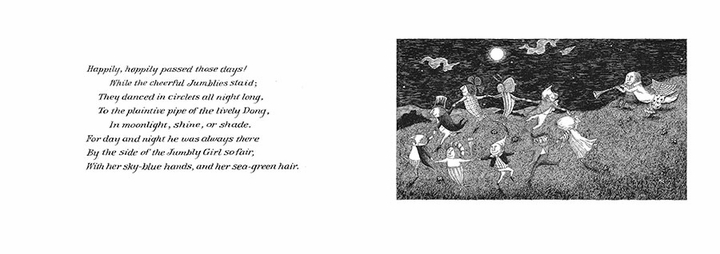
    Illustration by Edward Gorey

    *I would share the link, but my automatic embedder is giving me grief.

    **Ok maybe my mind is in the gutter.

  • Special Sounds: Describe rather than Prescribe

    I tend to get caught up in issues of notation, so it’s time for me to step back. Keep it simple.

    If you are a composer looking for a special kind of sound, but aren’t sure how to notate it, your solution may be as easy as adding a bit of text describing what you want.

    This seems like a no-brainer, but many composers feel compelled to add prescriptions rather than descriptions. A prescriptive direction tells the player how to execute the effect and does not describe the intended result. Unless you are a player of the instrument in question, avoid prescriptive indications like the plague. Here is an example: a prescriptive indication might say “use lots of air”, or “tight embouchure”.

    A more useful, descriptive indication for “use lots of air” might be “match the sound of the string harmonics” or “imitate a bamboo flute”. Matching string sounds and producing bamboo sounds are two very different techniques, but both using an airy type of sound, so it is helpful to have a descriptive indication to know which of these types of airy sound the composer might have in mind.

    The prescription “tight embouchure” might be “thin, reedy sound” or “like a buzz saw”. Again, very different means of production, so a description is helpful.

    I hope this has made your composing day a bit easier 🙂

  • In the Middle

    Thoughts provoked by working on the middle section of a large piece. Today I focused on pages 14 – 16 (of 21) of Aperghis’ the Dong. What goes on in a composer’s mind at this point? Was it a middle point when it was conceived? How will I survive to the end? How do I keep the audience interested in listening to the piccolo for another 4 or 5 minutes? If I don’t keep their interest, perhaps they will kill me as Scheherazade was doomed, yet she survived. Should I sex it up? If so, whose sex? What would you do?

  • Riches

    Some musings on current and future collaborations:

    Yesterday I discovered a new sound on my bass flute. It is high-pitched and horrible and usually something that I try to avoid. But like some things, under magnification or extreme pressure, it can yield a diamond-like beauty.

    I discovered this sound during my first session with composer Javier Vázquez, who is composing a duo for flute and percussion to be premiered with Dirk Rothbrust (probably via video) in June. In our session, I attempted to imaginatively sonify different urban environments – the area around Cologne Cathedral, train station and the Rhine. To be honest, the Rhine kinda scares the crap out of me. Its volume is way too much for the narrow channel it flows through. It flows so fast that in the past, after barge crashes, some containers never get found. They are driven into the river bottom by the current, I guess. Imagine not being able to find something the size of an 18-wheeler. Anyway, this is what I was thinking about during the improvisation and made that horrible but potentially useful sound.

    Another collaboration that has evoked new sounds has been with the composer Tomasz Prasqual, who is writing a duo for flute and Moog synthesizer to be performed with Uli Löffler in May 2022. We have had many Zoom sessions in which while improvising I get so lost in the sound that afterwards, I have no recollection of what I just played. This probably happens to many of us who do this :). Tomasz and I have both have Moogs (mine is a VST) and it has been great getting to know a new instrument. Really, really looking forward to this piece.

    I opened a can or worms with Georges Aperghis, when I told him I wanted a piccolo piece and liked the works of Edward Lear. Now I have to figure out how to sing higher than anyone wants to hear me, and recite the most bizarre text with a kind of straight face (well, straight enough to keep playing the piccolo). I am wondering about “The Dong“, its phallic implications and allusions to interracial love (after all, what else are the Jumbly Girls with their blue skin and green hair?). Hopefully, the premiere will go ahead as planned in Darmstadt this summer.

    Title still from Guy Maddin’s “Stump the Guesser”

    Many years ago, I approached filmmaker Guy Maddin and asked him if he would make a silent film for us at Musikfabrik, loosely or closely based on themes from Daniil Kharms‘ life and works. He agreed and with the support of the Acht Brücken Festival in May, we will perform (again, online) two commissioned works by Nina Šenk and Anthony Cheung to the film “Stump the Guesser”. Although I haven’t collaborated with the composers, I am chuffed (as the English would say) that a spark of one of my ideas lead to a working relationship with this awesome filmmaker!

    I have been trying my own hand at putting music to film, and am pleased to announce that last Fall I won a social media challenge for my film trailer to the (then) new Star Wars film. (Made with many flute sounds!) While researching film music for this challenge, I was appalled by the musical lack of experimentation in mainstream sci-fi. To those already in the field, I am sure this is a “known bug”. But seriously, people are projecting orchestral sounds from the 18th and 19th centuries on to scenes which should be taking place in future centuries! Where is the imagination in that? Of course there are many cool exceptions, but it’s time to move on, people.

    Last but not least, next week I am doing a remake of Ole Hübner’s “This place” for solo flute and layered video. Normally I don’t like pieces that deconstruct or make use of direct citation, but Ole has really rocked Dufay’s Nuper rosarum flores, and I am majorly challenged with gnarly bass flute harmonics, multiphonics and circular breathing. What more could a flutist want?

  • Style Guide for Composers

    If you are a composer looking for general-purpose layout advice, or a performer/group looking for a single page reference guide to give to the people who write for you, here is a document my colleagues and I at Musikfabrik have come up with. It is by no means exhaustive. One could read the 704-page Behind Bars by Elaine Gould, but we have tried to distill everything on to one page. I should also apply the disclaimer that these guidelines reflect our own ensemble culture at the present time.

    Here is the link in case the embedding does not work below:

  • Extended Techniques for Flute – Notation Cheat-Sheet

    So here is my attempt to get a lot of information to you quickly and succinctly via Google spreadsheets. The photo quality is not so good, but this way I can make quick changes, and you are always viewing the latest version. This is not an exhaustive overview of all notation practices – it is a quick-fix if you are looking for a standard, acceptable notation.

    You can go to this document directly and download it as a PDF or view it here:

  • Using Harmonics: Making Difficult Intervals Even Harder! Why?

    If you have a difficult interval in any kind of musical passage, playing the second note as a harmonic makes it even more difficult. You have to put more effort into directing the air and controlling the air speed. Once you have done that though, going back to the original passage without the harmonic seems pretty easy! I see this as good training, the way a weight lifter will shift from heavy weights to light weights (not that my lazy self would really know about this, lol.) This week, working on student compositions, this kind of practice has saved me. However, this time I am applying it to piccolo, and it really works.

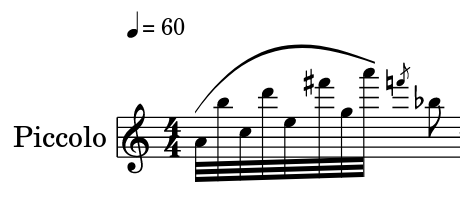
    The passage in question is as follows:

    The last four 32nd notes were troublesome. So I took the E – F# interval and repeated several times slowly, using the F# fingering an octave below (you could also use B natural):

    And the A – G interval like this, again repeating several times slowly and with an altered (but still overblown) fingering:

    It doesn’t sound pretty! (At least when I play it.) But it does make you work, so when you go back to the original passage, it is much easier!

    Any other thoughts? Other applications of this technique?

  • Gesang | Gesicht

    Today is the long-awaited “premiere” (Corona-style – that is, online premiere) of a project that has been brewing for more than a year. Here is the video performance and the notes below. Many thanks to the Frauenkulturbüro, NRW for their generous support, and to the Altefeuerwache Cologne, who could have closed their doors on me but did not.

    Project Gesang | Gesicht

    Helen Bledsoe, Concept, Music, Flutes, Electronics

    Carla Jordão, Choreography, Costume, Dance

    Timm Roller, Sound Design

    Lea Letzel, Stage Installation and Light

    Program:

    Browbeat – for flute and electronics

    Gesang | Gesicht – for dancer, flute and electronics

    Project Gesang | Gesicht: an overview of the music, staging and sources of inspiration by Helen Bledsoe

    At the beginning of the 20th century there was a fascinating Futurist movement in Russia. Scientific discoveries from the 19th century, cultural encounters with the Far-East and the rise of parliamentary democracy acted as catalysts for artistic ideas, culminating in the polemic, anti-elitist Futurist Manifesto of 1912*. This movement was brought to a halt in 1917 during the Russian Revolution. The Futurist movement, although short-lived, produced a huge body of work by progressive artists whose ideals of universal brotherhood and trans-cultural understanding have relevance today. The wish to keep these ideals alive was my inspiration for the project.

    Our abstract, minimalist stage design was inspired by the concepts of Rayonism, which was an outgrowth of Russian Futurism founded by Mikhail Larionov and Natalia Goncharova. These artists were inspired by metaphysical developments and discoveries such as radioactivity and higher-dimensional mathematics, which lead them to adopt concepts of transparency and fractured objects: their world was no longer purely solid and concrete. Our stage begins as a black box. As the music develops, strands of light are slowly lifted, creating rays of light that suggest transparent and permeable layers.

    The music and dance were inspired by another leading light of the Russian Futurist movement, the poet and visual artist Velimir Khlebnikov (1885-1922). He was extremely prolific and enjoyed a rock-star type of fame during his relatively brief career. I have chosen one of his early poems from 1908, Bobeobi, as the musical basis for this project. The words of the poem provide phonetic material; the spoken text (in the original Russian) was sampled and processed for the electronics. Browbeat for flute and electronics is based on the third stanza of the poem, “Pi-eh-eh-o sang the brows”. Gesang | Gesicht for dance, flute and electronics uses the first five stanzas as a structure:

    Бобэоби пелись губы,
    Вээоми пелись взоры,
    Пиээо пелись брови,
    Лиэээй — пелся облик,
    Гзи-гзи-гзэо пелась цепь.

    Так на холсте каких-то соответствий
    Вне протяжения жило Лицо.

    Bo-beh-o-bi, sang the lips,
    Veh-eh-o-mi, sang the glances,
    Pi-eh-eh-o, sang the brows,
    Li-eh-eh-ey, sang the visage,
    Gzi-gzi-gzeh-o, sang the chain.

    Thus on a canvas of such correspondences
    Beyond dimension lived a Face.**

    This poem, though early, embodies three important concepts of Khlebnikov’s mature works.

    1) The idea of a universal language

    The use of “Zaum”, the trans-rational language used by the Russian Futurists where derived, imagined words or individual phonemes are used as a meta-language. Klebnikov was convinced that all sounds found in language have a deep, universal meaning that is shared by all cultures. Thus understanding can be made immediate, transcending or bypassing rational thought. Contemporary musical language uses this concept to a certain extent. By deriving its own rules for melody and harmony (like “Zaum” derives or imagines words), it idealizes originality while assuming (falsely) that all humans have a common frame of musical reference. This contradictory idealism is something I attempt to musically explore.

    2) Higher dimensions

    Space and time are over-arching aspects of the poem. We assume a living face behind a painted portrait, are their dimensions parallel or will they intersect? To me it seems they exist in a state of quantum indeterminacy, yet perhaps they can hear one another, hence the songs. Klebnikov expresses this indeterminacy – and/and as opposed to either/or – by the ambiguous use of reflexive verbs, untranslatable into English or German. Our choreography is based around this concept. Most of the time, there is one body on stage, yet there is another lurking presence that manifests itself visibly and audibly at times. Their paths do not cross, yet at times they act together.

    3) Khlebnikov’s concept of sound-painting.

    As a synaesthete, Khlebnikov experienced consonant sounds as colors. In his notes and writings he made detailed correspondences between sounds and colors. I also imagine Klebnikov associating the physical act of painting a living thing (such as a portrait) with sounds. Thus the facial features, one by one, are not merely painted but brought forth by sound. He was an artist himself, although we don’t know for sure which or whose portrait the poem refers to. The initial letters of the first five stanzas (the “songs”) in Bobeobi are associated in the following way:

    StanzaInitial LetterColorObject / Facial association
    1BRedLips
    2VDark BlueGaze / Glance
    3PBlackBrows
    4LWhiteVisage. The sound L also indicates the diminution of the distance between the knowing mind and the knowable.
    5GzYellow / GoldChain (Necklace)

    In both pieces, Browbeat and Gesang | Gesicht, the concept of sound-painting plays a formal rather than a visual role. As mentioned above, the sampled sounds used to compose Browbeat include the stanza, “Pieeo sang the brows“, spoken in the original Russian, and a few flute sounds. The corresponding color of the “browsong” is black. Black in this sense is deep, as the brows provide a deep socket for the eyes. In the dark, unperceived events take place, erupt, dissipate and make way for dreams.

    Gesang | Gesicht is divided into three major sections based on phonetic material (not always recognizable) from the first three lines of the poem, corresponding to the consonants B (Red), P (Black again, the extended flute sounds from Browbeat reappear), and V (Dark Blue). The remaining sound elements of L (White) and GZ (Yellow) were chosen as bridges because L (White) has associations with changing distance, and GZ (Yellow) is paired with the chain (necklace). However, they also interject themselves briefly into the main sections.

    * Read my translation of this manifesto here: https://helenbledsoe.com/?p=238

    ** My translation. There are many possibilities, and I am aware that I have cut corners by choosing the simplest. For recitation purposes I have chosen to keep the active instead of the passive voice, its rhythm fits the music and direct correspondences I am trying to underline. For further reading: https://winterings.net/2017/01/29/bobeobi-by-khlebnikov-part-one/