Category: contemporary music

  • Multiphonics: Tips for Study

    Actually, this is a “notes-to-self” entry disguised as “Tips”. There are good sources for learning and practicing multiphonics such as Robert Dick’s “Tone Development through Extended Techniques” (although I know the term “extended techniques” has gone out of fashion, but the practice in the book is solid). I also have a detailed presentation where I approach learning multiphonics through the study of flute harmonics and spectral hearing. If you know of any other learning materials, please share them in the comments.

    Now to the notes-to-self. It is well and good enough just to learn and practice multiphonics, but time has shown that one is often asked to perform multiphonics under less-than-ideal conditions. This goes especially for ensemble pieces when there are others playing, and it is difficult to get aural feedback from your own playing in order to make the minute adjustments necessary to play a multiphonic. However, in solo works there are also challenges, where a multiphonic might be difficult to approach in context (in a series of them, or after a particularly tiring passage, for example). So how do I prepare for that? Part of the answer is simply training in-context, as well as the reassurance that experience will bring. At times it is helpful to ask yourself, or the composer, conductor, or chamber-music colleagues which note in the multiphonic is of most importance? What voice should I bring out? Perhaps most important of all: can I find a better fingering?

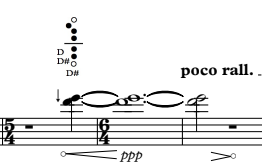
    And sometimes the composer thinks that he/she is helping by saying “oh that’s ok, I want an unstable sound, you can vacillate between the notes”. OK. That is something that has to be practiced too, because often a vacillation comes with a sudden jump in dynamic. In most cases, this is not the effect the composer is going for. This led me to a practice that I think is very helpful for close multiphonics such as this one (taken here in context from Joseph Lake’s Concerto for Prepared Piano):

    I should emphasize that the basic way to approach a multiphonic is to take it apart, get to know the dynamic range of all the notes, do the throat tuning to the weakest, etc. etc. These steps have been covered in tutorials by myself and others. But once this has been done, we often get caught up in trying to get both notes equally, and then still failing. In past tutorials, I talk about using fluttertongue to help find the position of the tongue that will work, and listening and aiming for the difference tone or beatings of the notes rather than the two notes themselves (logically, aiming for one thing is easier than aiming for two, right?). Another trick to throw out is to practice this vacillation that composers are so fond of – slowly. If you can control going between the notes slowly, and minimize the jump in dynamics that sometimes accompany the movement, I find that the actual multiphonic sounds more than you expect.

    So those are my thoughts from today’s practice, if you have anything to add I would be curious to know.

  • Postlude to a Premiere

    This is more of a public diary entry and notes-to-self than any sort of attempt to give tips or tools. Also, I attempt to sort out my thoughts of how things have changed in Darmstadt since the late 90s.

    It’s been a few days since I premiered Georges Aperghis’ fascinating and wonderful The Dong with the Luminous Nose, and I am tired of mental postmortem self-criticisms that keep bubbling up into my consciousness. I need head-space for my next projects!

    This piece really should be played from memory. The fact that my main achievement of the evening is I didn’t f-up the page turns with my page flipper is a testimony to that. And that the batteries didn’t run out. The list of why I didn’t play from memory is a long one – the final version of the piece was set 3 weeks before, and in that time period I had an opera to play, a family to have a kind of summer vacation with, and very time-consuming hobbies.

    I was glad that there was a quality video recording, but am also happy that the recording is being removed from YouTube today, because although as a performance it was ok, I don’t want it to be the “definitive” version of the piece. Although that is a kind of joke. Little of the dramatic actions, voices, costume, that I did is actually in the score, so there never was and never will be a “definitive” version. There are no indications of how gestures are to be performed, the piece also has only two dynamic indications. For me, this is poses a very interesting interpretive situation, and has many parallels to my study and engagement with electronic music composition. Like electronic music, music that involves declamation of spoken text, a mixture of spoken text with instrumental sounds and dramatic gestures, cannot be prescribed with conventional musical notation. It puts performance, and not the written score, at its center. (Watch this documentary about Aperghis and musical theater if you want to know more about his esthetic.)

    This situation for me was interesting because I gave the premiere in Darmstadt, where composition, composers and the “text” of music, i.e., the score, have historically been the focus of attention and resources. When I first attended in the 90s, I was struck by the hegemony of composers there, and their dominance, along with big-name festival organizers, in the whole contemporary music scene. There were very few composer-performers as role models in Darmstadt at that time (Markus Stockhausen was one exception), and the concept of composer-performer or improviser was neither thematized, promoted, nor rewarded. I was even advised there by a local composer to “stay away from the improv scene”, those players were really considered lame. This has changed, and I think this normalization is due to rapidly evolving technology and the emerging inclusiveness that is the result of successful activism and increased “woke-ness” by our cultural power structures.

    As pointed out in Live Electronic Music, Composition, Performance, Study, our music history is written “from the perspective of the composer and rarely from that of the performer. Compositional outcomes have been the backbone of music historiography since it began in the 19th century”. This book examines questions of musical texts that are “nonexistent, incomplete, insufficiently precise or transmitted in a nontraditional format” from many perspectives (that of composer, performer, audio engineer to name a few). Historically, it makes sense that anything that leaves a paper trail (a score) will become a source for academics to pour over. We love artifacts. They provide a basis for taxonomies, give credibility, establish lineages, give credence to ideas. Since recording technology has developed, we have now another fixed source, that of recorded performances, over which to pour. This has “…opened up new perspectives, which have contributed to the revitalization of the performer’s role and the concept of music as performance.” I love this book!

    Now is the time for composer/performers, improvisers, and those who work with media whose sounds cannot be codified/”textified” by a score, to assume more prominence in our Western music history and the power structures that determine our cultural life.

  • Multiphonics for Saunders Bite

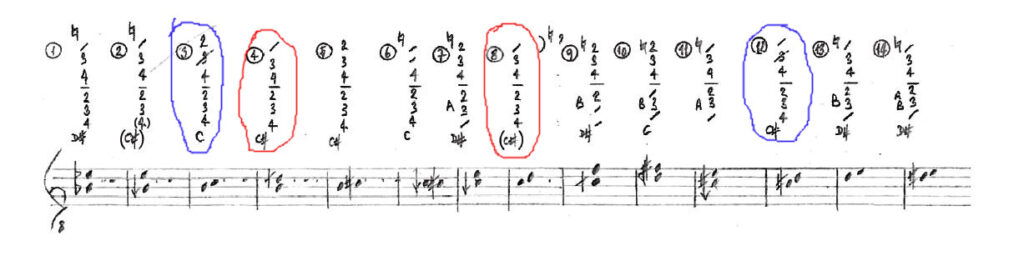
    I am very pleased that a number of young flutists are learning Rebecca Saunder’s Bite for solo bass flute. However, I am a bit ashamed that I did not have a good look at the multiphonic table in the earliest versions and insist on alternatives and corrections. Better late than never! Here goes:

    Multiphonic table from Saunder’s Bite. Blue circled ones need open holes, the red ones are just wrong.

    I’ll address them one by one. However, a preface to all of them in general: you are allowed to make substitutions, if a multiphonic just refuses to speak. Find something similar, or replace it with one of the ones given. I also won’t remark on the microtonal variations, some of the written notes are about a quarter-tone off. Don’t sweat it or try to tune it, just use the fingering if it works.

    1. ok
    2. ok
    3. If you don’t have the open hole, I suggest substituting this one with number 5. If you think of another solution, I am curious!
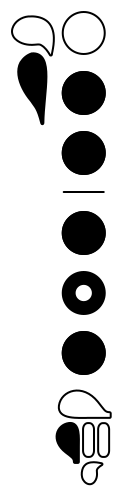
    4. I think this one was meant:

    I would substitute number 5 for this one too, if you don’t have an open hole. However, it is used rarely (I’ll have to check, maybe not at all in the final version).

    5. ok

    6. ok

    7. ok

    8. Forget the C# in parenthesis. This one needs to be rolled out quite a bit.

    9. ok

    10. ok

    11. ok

    12. If you don’t have an open hole, substitute with 11 or thirteen, depending on what sounds better for you in context.

    13. ok

    14. ok

    Some are really tricky to produce, try rolling way more out or in that you normally would, or experimenting with the position of your tongue. Book a Zoom lesson if you really need help. Good luck and have fun with the piece!

  • Getting Started with Multiphonics

    I would like to share the following presentation: Getting Started with Harmonics and Multiphonics – with a deep dive into the harmonic structure of the flute sound.

    Why do I start this presentation with a discussion on harmonics? Because if you learn how to take out, put in, and isolate harmonics in your sound, harmonics and multiphonics will come more easily.

    Since this is a work in progress, I will share a link to Google Slides instead of putting the content here. That way you can always view the latest version. Share your feedback, ideas, and corrections in the comment section here on this blog.

    Big thanks to Julianna Nickel and her flute studio at George Mason University for inviting me to share these ideas. It was great to bounce around these thoughts, hear questions and receive feedback. Thanks to Studio Musikfabrik for initiating and funding this pedagogical initiative, which will result in a tutorial video scheduled to come out sometime in the Spring of 2021.

    https://docs.google.com/presentation/d/1XZQvK567OgoM7MREmTqYzT0j6712FiIURzQJ-AZtrNQ/edit#slide=id.p

  • Too Many Flutists

    The phrases “there are too many flutists today”, and “conservatories are producing too many flutists for too few jobs” may be true in a certain respect, but they really sadden me. And piss me off, if I really admit. It has been hard to put my finger on exactly why, but when a friend posted Seth Godin‘s “Toward abundant systems“, it helped me to put my thoughts in order.

    Industrialism is based on scarcity. So is traditional college admissions. In fact, much of the world as we know it is based on hierarchies, limited shelf space, and resources that are difficult to share.

    These are his opening words. He goes on to describe which systems thrive on abundance rather than scarcity (language, for example). Then he makes a convincing argument that we need to realize education as an abundant system too, rather than the scarce one that it is today.

    He sees this realization as a cultural turning point. I would also like to see a turning point in our musical culture, and its education, as we realize that music, and in my personal argument, flute playing (and by implication earning a living as a flutist) as an abundant system. That means a turning away from the narrow training on offer at most music schools. I believe this narrowness is at the root of “too many flutists”, not the lack of orchestral jobs. Yes, there are too many flutists for too few orchestral jobs.

    What lies behind this “too many flutists” statement is the arrogant implication that “in order to be a good flutist, you must win an orchestral audition”. This may be unconsciously arrogant, but nevertheless it is unsupportable. Even more perfidious are those individuals and institutions that attempt to capitalize on the scarcity of orchestral jobs by setting themselves as the elite arbiters of what is the right way or wrong way to play.

    Being an orchestral player has a status in its own right. We should refuse to let scarcity define this status.

    Yes, aspiring orchestral players need top trainers. But as I have written elsewhere, young players need more.

    In closing, I paraphrase Godin’s words: if we can break [musical] education out of the scarcity mindset and instead focus on learning that happens despite status not because of it, then we can begin to shift many of the other power structures in our society.

    A shift of power structures means a shift of resources, and that is definitely what the Arts need now!

  • Contemporary Music Pedagogy, and Benefits of Teaching Extended Techniques

    [This is an excerpt from a questionaire sent to me by Lorenzo Diaz for research purposes. The answers represent my opinions only.]

    Do you think conservatoires and schools of music really attach importance to contemporary music education?

    My short answer to your question is not reallybecause I think a Comtemporary Music Educationshould require not only teaching contemporary repertoire and its extended techniques, but should also require learning extended use of rhythms, different tuning systems, composition (especially for the performers) and improvisation.

    Here is a longer answer: An increasing number of schools do attach importance, at least formally. In Europe, the Bologna process has helped by offering specialized Masters programs such as Masters in Contemporary music. The appearance of prestigious Academies and Festivals such as the Lucerne Festival, the academies of Ensemble Intercontemporain and Ensemble Moderne has helped to draw conservatory students’ (and their Professors’) interest.

    I am not sure if this is happening outside of Northwestern Europe, but here there is a trend, usually initiated by Composition Departments (not Instrumentalists!), to create formal student Contemporary Music Ensembles, and hire personnel (part-time) to run it. This is a great thing, it creates jobs, gives the student composers an outlet for performances, and gives instrumentalists a chance to play contemporary music and receive formal credit.

    These are formal, structural changes that I have witnessed in the past 20 years.

    Although I have listed positive changes above, I think still in many schools there is a lack of integration of repertoire from the late 20th/early 21st Centuries. Personally, I would like to see Composition Departments taking even more responsibility and action to help make the needed changes. It can’t come from instrumentalists alone. Composition teachers could do this by focusing more on teaching the basics of Instrumentation/Orchestration, which is becoming a lost art. This would avoid basic mistakes and misunderstandings that can lead to distrust. They could encourage more programs or situations that encourage collaboration between student composers and instrumentalists. (Such as creating, taking part in or seeking funds for programs like Composer Collider Europe.) When a piece of contemporary music does not go over well with a student, they and their teacher are likely to criticize the music or the composer, rather than to criticize the situation that provides little opportunity for collaboration, preparation and practice.


    In your opinion, is teaching extended techniques really necessary in the academic environment?

    I think it is necessary to be able to offer them. They are part of some required repertoire for competitions, and can assist in embouchure development and control of the air stream. However, there are great flutists today who have never utilized extended techniques. I would not say it is absolutely necessary, but it is practical.

    To be completely honest, I think that to be a contemporary musician, on the technical level it is of first importance to learn the complexities of modern rhythm (polyrhythms, odd time signatures, etc.) and intonation (microtonal, spectral tuning, etc.). This will strengthen a student’s sense of rhythm and intonation, skills that are necessary to find a job in an orchestra, ensemble or theater. Learning to improvise and compose (just so you have experienced the process that a composer goes through) are the next most important things, to make one more completely rounded. Where do extended techniques come in? Again, I think it depends on the student, if and when they need it for embouchure development, or to play certain repertoire, or to expand their improvisational vocabulary.

    Do you think conservatoires should include more musical works using these resources in their academic programs?

    I think that more exposure to works with extended techniques should be encouraged. Repertoire with these techniques is becoming standard for auditions and admissions to festivals, competitions and places of study.

    In the case you reckon that the study of these techniques in students of elementary and professional level is possible, which technique (or techniques) would be preferable to apply from the beginning? Is there any one in particular that would be rather applied later on?

    It really depends on the student. If there is already the range of an octave, and the student has a good understanding of how to coordinate the air and embouchure, then harmonics can be introduced (we need the technique of overblowing anyway to play notes in the second octave). Circular breathing can be introduced as a concept from the beginning through the use of a glass of water and a straw, or the use of an end-blown tube like the didgeridoo. Application to the flute would come later, once the student has developed a good concept of embouchure and is flexible enough to come back to it after the modifications necessary for circular breathing.

    Is there any technique in particular that has proven to be more effective throughout your study?

    Harmonics are the most basic, I always turn to them in times of trouble.

    Do you usually request your students to study some effect on a daily routine, just as well as any other given technical exercise? If so, which one?

    Again it depends on the student. Harmonics are good for anyone, and I encourage all students to practice them daily.

    The “trumpet sound” has aroused controversy regarding its use; flautists as R. Dick would rather it not be written in order to avoid a counterproductive effect in the lips, do you agree with this?

    The counterproductive effect is only temporary. I use this effect in improvisation, however I discourage composers from using it. I have little faith that it will be written in a context where it will be appreciated acoustically or in a way that will avoid the counterproductive effect.

    Do you usually use any of the following extended techniques, both on your study and with your students (daily, at any given time…)

    Air: Yes sometimes. In a conversation with Sophie Cherrier, I got the idea to spend 10 minutes a day on loud air sounds in order to get the air column working. Of course, she does not recommend doing this with students who already have too much air in the sound, but for those who are too tight or too focused, this really works. I do it myself when I remember.

    Voice: Yes, I recommend this to my students and have exercises for it.

    Whistle tones: I teach these as needed. There was a time that I played these every day in order to play the first octave whistle tones down to low C. That was hard, but once I could do it I don’t need to do it every day.

    Bamboo: Only on request or as needed in the repertoire.

    Flutter tongue: Sometimes I recommend this as part of articulation training. Aurele Nicolet recommended that fast, articulated passages should be practiced legato and with fluttertongue.

    Pizzicato: Only on request or as needed in the repertoire.

    Key clicks: No.  I try to discourage composers from using it. Pizzicato is much more effective.

    Jet whistle: as needed, some players think it opens up the sound of the flute.

    Circular Breathing: I teach sometimes, on request. Benefits can be as a checkpoint for resonance. When I am warming up or just about to go onstage, I check my circular breathing regardless if it is required in the piece I am about to play. This is a sure-fire test to see if either of my nostrils or the back of my throat is blocked. If I am clear enough to circular breathe then I should be able to play with maximum resonance.

    Tongue Ram: In conversation with Sophie Cherrier she mentions that she sometimes teaches Tongue Ram in order to get a student to activate the abdominal muscles. This is something I plan on doing, should I have a student who needs this. I have tried it myself, not something I do every day, but occasionally it is a good activator.

    For more information about the benefits of extended techniques, please see this handout.
  • Performing Luigi Nono’s Flute Music

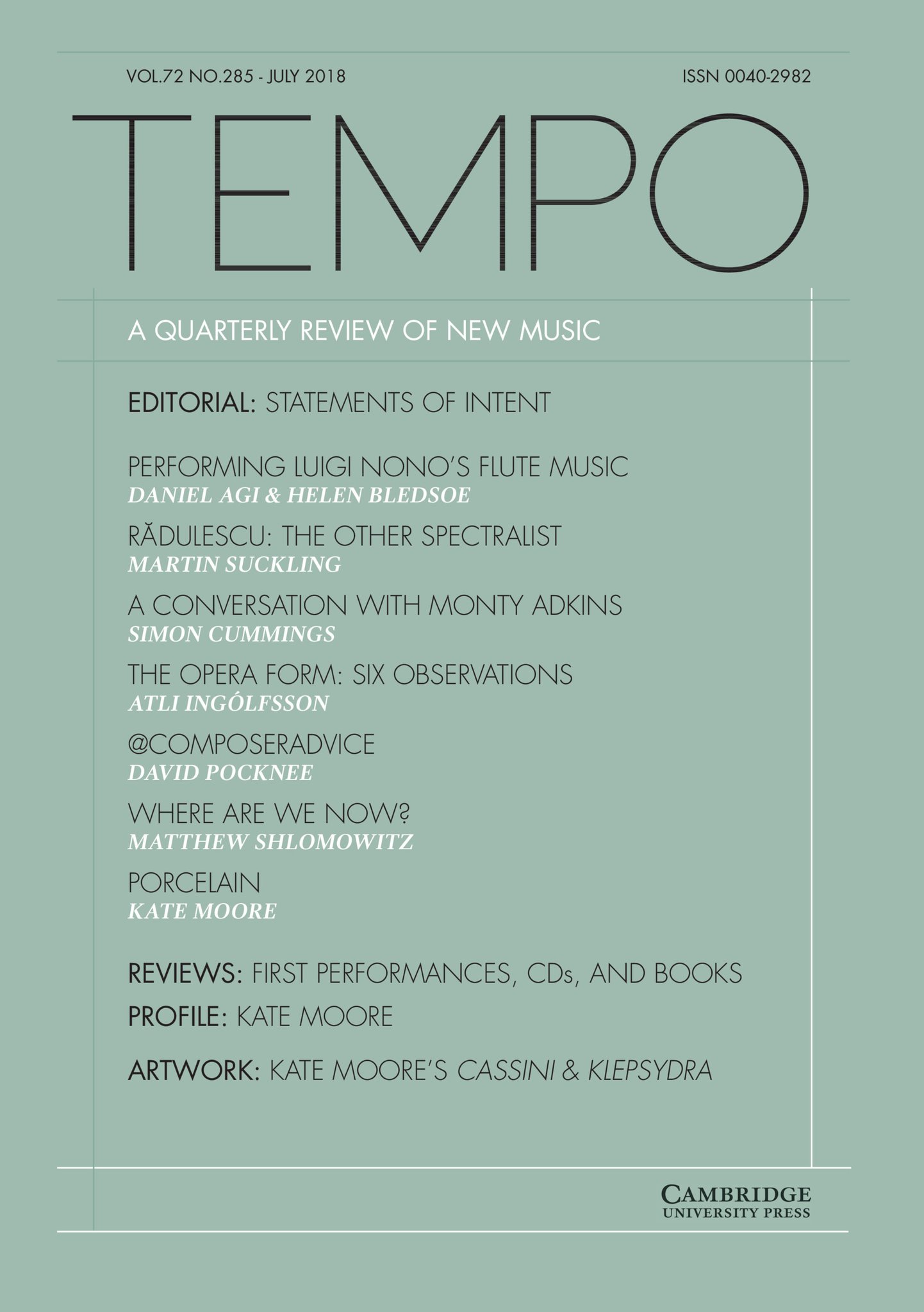
    I am very honored to have been invited by Daniel Agi and Tempo magazine to contribute my experience of performing Luigi Nono’s music. Our article has been published; here is the abstract:

    “A performer of Luigi Nono’s late works is often faced with crucial questions regarding interpretation and technical details. An important tradition has evolved in performing these works, nevertheless it is not always easy to find the necessary information to play them adequately. This article attempts to answer some of the technical and interpretational questions in the context of Das atmende Klarsein and A Pierre – Dell’Azzurro silenzio, inquietum. Our hope is that it will contribute to the discussion about authenticity and freedom of interpretation and provide flutists with practical information not found in the scores.”

    Here is the link to the abstract and citation.

    Here is a link to a share version of the full article.


  • Which extended techniques are harmful to flutes?

    During composer workshops, I am sometimes pleased to hear the question: “What are some techniques we should definitely not use because they may harm your instrument?”

    So I will keep a running list here.

    • Slamming your hands onto the keywork. A snap of the finger for a key click is one thing (and not all flutists like to do this, including myself), but once I was actually asked to raise my arm above my head and bring my hand down full force on the keywork. Repeatedly. For some reason, I had trouble convincing this particular composer that this might actually break or bend the posts and rods holding the keys in place.
    • Immersing part of the flute in water. If water, even a tiny drop, gets onto the key pads, the pad can swell up and not seal properly (and it may need to be replaced). The same can happen when pads are exposed to excess moisture, which is why I do not like to play out of doors, but that can’t be helped sometimes.
    • Putting your mouth directly on wooden lip plates. This is why I get out my plastic piccolo if I have to do a tongue ram or any percussive effect that requires me to close the embouchure hole with my mouth. Salivation is the first stage of digestion, and I don’t want the result of those chemical processes on finely carved wood.
    • (Not an extended technique, but please bear in mind.) Extreme temperatures. With metal flutes, key pads and the mechanism might go out of adjustment. With wooden instruments, it can be fatal! Some insurance companies will not even pay out if damage occurred while the instrument was below or above certain temperatures.

    I am sure I have forgotten something!