In my last entry, I made some sarcastic remarks about the tempo in Berio’s Sequenza for flute being too fast. Now with genuine curiosity, I would like to probe composers’ psyche in the hopes that it will reveal why given tempi are often too fast. I will try not to make this a rant.
Given today’s technology, it is not surprising that computer generated scores can churn out notes at a certain tempo that sounds “correct” when electronically reproduced. Then when produced with actual living, breathing creatures playing mechanical objects, the composer realizes that compromises or adjustments to tempo have to be made. That is understandable. However, I encounter this phenomenon with pre-technological pieces as well as contemporary ones that were composed away from the computer.
The problems I see when a tempo is too fast:
Variations in division of the beat are poorly perceivable. Personally, I like my quintuplets to sound like quintuplets, and be discernible from sextuplets or sixteenth-notes.
Variations in pitch are poorly perceivable. Not only are fingering and lipping microtones difficult at high speeds, but can you really tell in a blur of notes if I play an F or an F a sixth-tone high? Should I really bother? [When I (and probably most flute players) get excited about a loud, fast passage, my F, and all the surrounding notes, will be a sixth tone higher whether I like it or not.]
Variations in articulation are poorly perceivable. If inflections of long and short are important, I would appreciate time to produce them and to make sure the audience has time to capture them.
Sometimes I am annoyed when I point out these things to a composer, and the response is: “Oh, that is the tempo you strive for, the ideal tempo.” Well, do I really strive for that tempo (which I can achieve in some cases) and sacrifice the musical details? If you know me already from reading my blog, I am at my worst when presented with conflicting information. I do appreciate conflict as a positive creative force, but do not appreciate it when it is a result of artistic laziness.
But I am a nice person, and cannot believe that the majority of composers are lazy. So what is going on?
Several days until I record the Berio Sequenza no. 1. This winter break has been very stressful. I was with my family in St. Petersburg. Family can be stressful, my son is at a difficult age, I myself am at a difficult age. Russia is stressful. It was so cold that it has taken my skin and lips days to recover. But now back in the saddle of my bicycle in the temperate zone of Northwestern Europe, I have hit my stride.
I am allowing myself a luxury. Next week there are plenty of pieces to prepare, old and new, but I decided to forget about them and devote my practice time to concentrate on Berio.
The main reason is that my body feels soooo much better when I keep my practice time to only a few hours a day. This is how I want to feel during the recording. So I warm up, play Bach for sound, articulation, style and focus. (Watch Pahud’s video: https://www.youtube.com/watch?v=yUxY7tagf0g where he gives his ideas on playing with focus. I practice like this with either one or two movements of Bach. I don’t recommend learning new pieces like this, but with pieces you know well, it is a great lesson.) Then Berio. Then for the rest of the day I do my Helen stuff, read, hang out with family, watch dumb and smart stuff on Youtube, study Jazz. This is luxury, as I have said. No rehearsals or teaching this early in the year.
It reminds me of a conversation I had with Camilla Hoitenga about new scores and recordings. You receive a new score along with a recording by the person for whom the piece was written. So you dutifully sit with the score and listen, but so much doesn’t correspond. So how do you prepare, follow the score or the recorded performance? You assume the player worked closely with the composer, and the composer is happy with the recording otherwise s/he wouldn’t have sent it to you. Even though I am sure I have been that player/dedicatee, I still don’t have an algorithm to navigate this situation.
Since Gazzeloni’s recording is very much of its own time, I doesn’t spin me into a crisis. I find it very revealing though. I won’t end up following his tempi, but there are quite a few turns of phrasing that inspire me to think differently.
About the tempo. I was talking to another local flutist who had worked with Berio on the Sequenza. He told me Berio complained that most players “play it too f(*&^ing fast!”. Well, I have news for you, Sr. Berio. You wrote it too f(*&^ing fast. Funny that the new edition doesn’t even adjust the metronome marking.
I have also enjoyed watching Paula Robison speak on the subject. (https://www.youtube.com/watch?v=irY1kHq_F3g) In the last section, she points out possibilities that Berio allows (one namely being a slower tempo). I was also interested to hear about how she connects the Sequenza to the works of Samuel Beckett. Through Berio’s electronic piece, Thema (Omaggio a Joyce), I was aware of the James Joyce connection, and Beckett does make sense. Through playing Rebecca Saunders music, I am quite familiar with some of Becketts’ texts. So another inspiration has surfaced 🙂
One big influence on Berio that I think really should be mentioned is that of the musicians around him, namely, his wife at the time, Cathy Berberian, for whom he wrote the third Sequenza. Her theatricality, her agility, never cease to inspire me. Only recently did I come to know she composed herself. Here is an example of her graphic score, Stripsody (https://www.youtube.com/watch?v=XHUQFGhXHCw).
I love her recording of the vocal Sequenza too, but I just came across a recent recording of the Sequenza no. 3 for voice by a young singer, Laura Catrani that fascinates me. (https://www.youtube.com/watch?v=E0TTd2roL6s). I can’t aspire to this type of recording, but it does give me food for thought.
I am unashamedly playing from the old edition. Being a creature born myself in mid-20th century, I am hoping the good people of Universal Edition will forgive me. The old version has been in my memory for about 20 years now. But I do own the new addition, and am finding it more useful than ever this time around to answer questions about timing. For an interesting discussion of the two versions you can read Berio’s Sequenzas: Essays on Performance, Composition and Analysis, Chapter one by Cynthia Folio and Alexander Brinkman.
[Taken with permission from an interview with Cássia Carrascoza Bomfim, in preparation for her doctoral dissertation]
Do you feel a lot of difference between playing works with a pre-recorded tape and computer processing in real time (Max/msp)?
Both ways present various issues of playing with a microphone. With a tape piece, I am concerned that the live sound mixes with the electronics. With computer processing, I have the additional concern to make sure I play in a way that my signal will be processed, which sometimes compromises variation in dynamics and articulation. For example while playing Nono’s Risonanze erranti with Musikfabrik, there is a measure where the piccolo is marked ppppp. However, if I play that dynamic as written, the signalisation will not register. If one has a standing microphone, then it is possible to play around with the distance between you and the microphone, but if you have a clip or contact microphone, this is not possible.
A pre-recorded tape piece may have the advantage of technological simplicity, and if it is well conceived, then it provides either freedom to allow asynchronicity or good cues (acoustic as well as notated) that facilitate synchronicity, and does not constrain the performer in terms of sound color and dynamic. A great fun, technologically simple piece I have played is David Dramm’s Thrash and Variations for Flute and Boom Box, where I just walk on stage with a portable CD player, and off I go! With real time processing, I feel artistically more free in terms of spontaneity of tempo, but have more worries because there are more things that can go wrong, i.e. program crash, more cables that can be defective, midi cables or an interface that can be defective. I don’t do the electronics myself and rely completely on my technician partner. So yes, I do feel differences.
In relation to your feelings of time and tempo, could you point out the differences between the two genres?
This is very dependant on the piece. Of course, there are tape pieces that offer you absolutely no freedom in terms of time, and in some cases I welcome a click track to help the coordination. There are some bars of Michel van der Aa‘s Rekindle that were challenging for me. This wonderful piece is cleverly done so you don’t generally need a click track, but there were a few bars at the end where there the flutist is only playing long notes and there is nothing going on in the tape part to give you a sense of pulse, so you really have to rely on your inner metronome to stay together. A piece like Stockhausen’s Paradieshas an unmovable and inflexible tape part, but a click track is unnecessary because much freedom is given to the performer in terms of the tempo. (There is theoretically also freedom with the dynamics, but since the tape does not offer dynamic differences, the player is rarely given an opportunity to play really softly.)
With live processing pieces, there is sometimes freedom of timing, sometimes not. For example, Saariaho’s Noa Noa gives the performer, by means of a foot pedal, the means to choose timing. However, the samples and effects that are triggered have their own programmed time, so if you rush, the sample or effect will not play out, or if you are too slow, there is an unmusical gap. (This piece may also be played without foot pedal, with the sound engineer following the score and triggering the samples.)
Premiere of Ole Hübner’s “this place”
Could you tell more about your experiences with click tracks?
With ensemble pieces, we often discuss if we should all have a click track or just the conductor (or if chamber music, just one of us). Not everybody translates the pulse of the click the same, some play more on the beat, others after, and we always argue about what kind of sound we should have for the first beat of the measure (high, low?) because depending on the tessatura of your instrument, it could make a big difference. So sometimes it’s more satisfying to play as chamber music, without a click track. A click also has to be well done and have helpful cues to alert us that we are coming up to a tutti or a new section or tempo change. Another issue is the division of the beat, or whether a beat is subdivided or not. We once played a piece that required a click track, but the click was extremely unhelpful because for the tutti sections, all divisions, even 32nd note triplets, were clicked! Such minutae is annoying rather than helpful since with a flurry of clicks, you can actually lose the sense of pulse. In general, it really depends on the individual piece and the quality of the click track, whether we decide to all have a click or follow someone with the click.
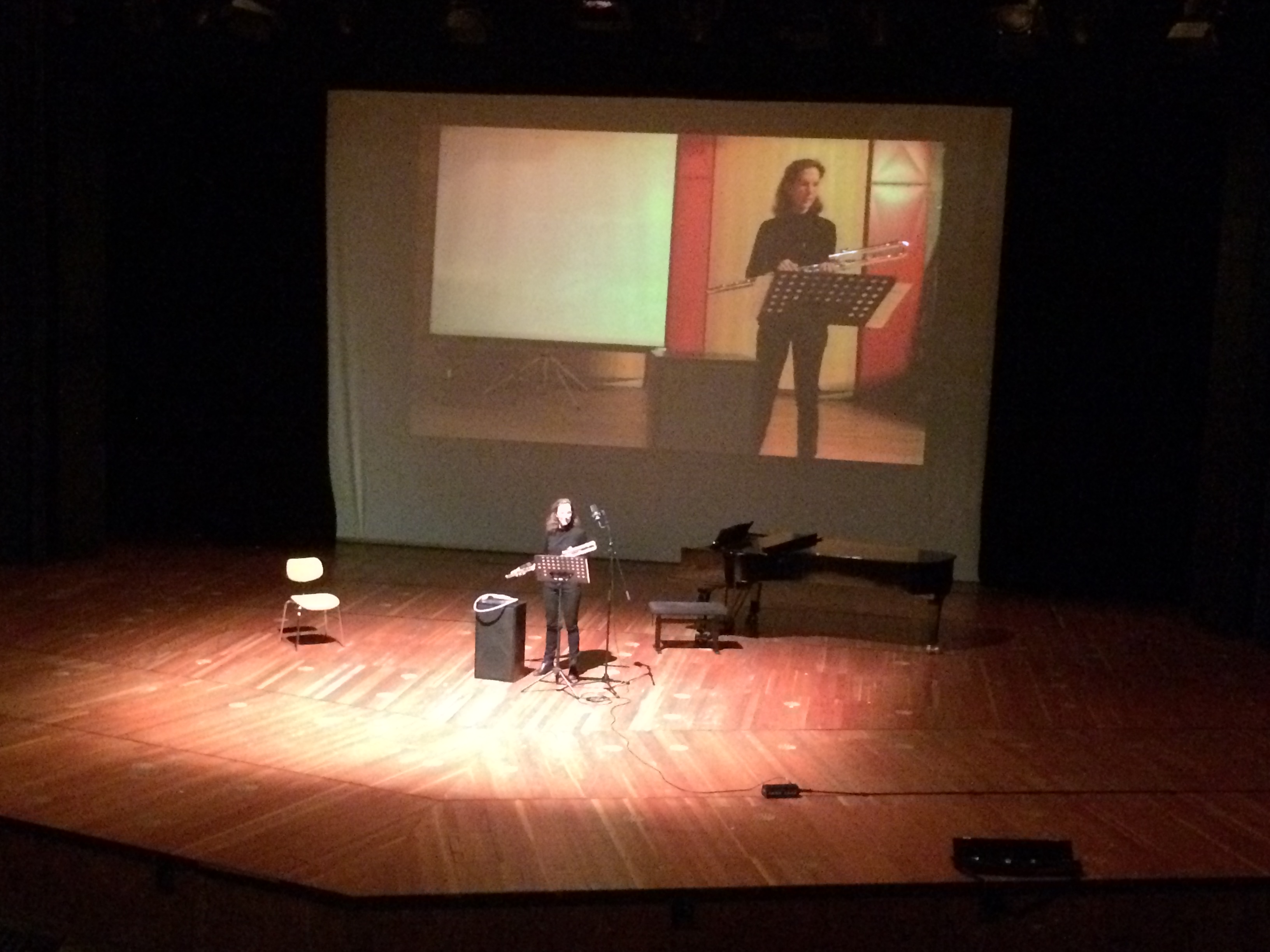
As a soloist I am happy to play with a click if it really helps. Recently I premiered Ole Hübner’s this place for solo bass flute, several layers of video and audio together (watch on YouTube here). When playing a coordinated sound track, a click is extremely helpful. The question for us was from where to run the click track, to send it from the computer to my headphones via cable, wireless, or for me to play it from my own device? For simplicity’s sake, I played it from my own device, just giving a cue for the start so my click and the recordings would be together. This can be risky though, if the starting cue is not together.
With real time processing there are other factors to consider when using a click track. Sometimes there is a latency of the signal processing. Then I hope the effects and the acoustics hide any imperfections of synchronicity.
If you are lucky, you get the click track in time to practice with it, especially if there are these sort of compensations that have to be made. In our experience, if you have a click track, it is really important to practice with it and not spontaneously rely on it in concert.
Do you think as rule, that you are more free (in the time sense) playing with processing in real time than with a pre-recorded tape?
For me the only time I feel completely free from questions of time is during improvisation. This can be a lot of fun with live electronics, but also effective with tape as in the last movement of Nono’s Das Atmende Klarsein. Whether I feel free depends more on the composition and the composer’s conception (and notation) of time than the technology itself.
In composition workshops, the question sometimes arises: in an ensemble or orchestral situation, how does one write dynamics for individual instruments? For example, if you want a balanced forte among winds and brass, does one write forte for the winds (assuming they are not playing in the altissimo register) but mezzo forte for the brass? Or does one just write forte for all instruments and expect the musicians (or conductor) to balance things out?
In spite of the wonderful composers (Ligeti among them) who have taken trouble to relativize dynamics for us, I would say: Write what you want to hear, not what you think we can play. Trust me. Let us do the musical work (or at least give the conductor something to do 🙂 ).
Other considerations: instrument building and playing techniques change over time. Abilities among players vary considerably. I can think of flute players who can drown out a brass section. If I were one of them, I would feel patronized by relative dynamics. Sadly, I am not, but I still feel sometimes annoyed by assumptions made by composers. For example, some composers assume a flute tone in the 3rd octave will be loud, so he or she will write pp for every passage in that register. Sometimes it’s obvious that is going on, sometimes it isn’t. What to do? Do you want your future performers spending their rehearsal time on your piece arguing with each other or putting your piece together?
This bears repeating:
Write what you want to hear, not what you think we can play.
This summer, for better or worse, I find myself without paid work for a whole month, so I have flown off to St. Petersburg with my family to enjoy the last of the White Nights. With one week left, I spend my vacation practice mentally preparing that which I have to play from memory, and mulling over thoughts about what is actually involved in creating musical expression. Once again, I have no particular point in this entry, just an accumulation of thoughts.
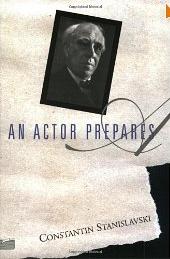
One of my goals this summer is to read Constantin Stanislawski’s “An Actor Prepares” in the original Russian. It’s very slow going, which is good in a way, since sometimes I tend to read too fast and not retain things. Theatrical, artistic expression is a big topic (so far) in the book, but I am wondering whether it is worthwhile to draw parallels to musical expression.
Playing a solo part has obvious parallels to playing a role in a theatrical work, but is it useful for musicians to really experience the emotions we are trying to convey, as an actor is encouraged to do? Stanislawski himself points out that experiencing the emotions is not enough. There has to be technical control over the use of one’s body and voice above and beyond feeling. I think that is the crux for musicians.
Here’s something that probably happens to most of us: I can really “go for it” in a high, ecstatic, fortissimo passage, passionate, all systems going full steam. However, if I really do that, my heart will be racing, and my center of energy and balance will be too high. If there is a sudden dynamic shift, I am up a creek, breathless, heart thumping, out of focus. Even in the moment of passion, there has to be a part of yourself that stays sober and reminds you to stay down, open and be ready for what’s coming. That part, I guess, is our technique. It is the balance of that sober part to our ecstatic part that makes our practice and performance so exciting.
I remember one thing Robert Dick told me. In abstract contemporary music, we often can’t rely on the use of recognizable rhetoric, or the Affects we learn about in Early Music. Sometimes we can’t even rely on the expression of anything recognizably human e.g., sad, happy, sensuous, hideous. However, what the audience will recognize is energy. That is what we must aspire to conjure. It may be that your energy will not be interpreted as you intended. I can’t tell you how many times this has happened to me, sometimes for better, sometimes for worse.
I’ll leave off by sharing a video with Barbara Hannigan, who talks about her preparation for the role of Alban Berg’sLulu. Few of us have the luxury of this deep level of preparation, but I found her dedication very uplifting. (ed. – In case you don’t make it to the comments section, here is another recommended video with Stephen Fry discussing the visceral experience of opera: http://www.youtube.com/watch?v=EVN4dShaZWk.)
Luciano Berio‘s Sequenza no.1 for flute is one of my favorite pieces. I also love teaching it; it has so much to offer in terms of technique (especially articulation!), style and presentation. There is an unwritten book inside me about this work, but for now I would like to consider one aspect of the work that often gets ignored: Intonation.
This is one reason it is not my favorite piece to listen to. If you know me, you know I don’t have perfect pitch, or even flawless intonation. Nevertheless, neither you nor I can assume that a work without a traditional tonal center and without traditional harmonic relationships is devoid of centers and relationships entirely. I would argue that in this context, these matters require even more consideration. I’d like to address this generally and specifically, not as a how-to guide, but as food for thought in your own practicing.
In general, there are rules of thumb for atonal solo works. Here I quote Doris Geller’s “Praktische Intonationslehre“, page 117 (my translation):*
In free-tonal music there is also a hierarchy of intervals, the most important points of orientation being the prime intervals (octaves, fifths, fourths), especially when they form tones that draw attention to themselves. These could be, for example, long, held-out notes or notes that follow a rest.
Here she is referring to Debussy‘s Syrinx, and gives specific examples. However, these words and her further advice to analyze goal notes, high points, low points, and melodic turning points can apply to all solo works. Edgar Varèse‘s Density 21.5 especially offers the same points of consideration.
Specifically for the Sequenza, I consider the soul of the work to be in the long, held-out notes. If you listen to the other Sequenzas of Berio, you will hear this particular pattern of drawing the listener in. Often there are rapid, virtuosic passages punctuated by the stillness of a single note, where the quality of sound and the relationship to its environment are of utmost importance.
*In a previous entry, I write more about Doris Geller and the intonation of melodic intervals.
I love it when a composer takes the flute in hand and explores its sounds while writing for flute. It shows more dedication and curiosity than just looking up techniques in a book (not to disparage the good books about writing for flute). Sometimes, it can produce an original sound, but sometimes it re-invents the wheel. Which is fine, but the wheel may come with a new symbol and complicated instructions. I have seen this cause frustration, esp. when the instructions are lengthy and not in your language. Once you reach understanding: “ah ha, so it is ____(fill in known technique)” it may be easy to adjust to a new notation. If not, then I am faced with the question, do I spend time re-notating, or visually re-adjusting to the score? This is something I will come back to.
In no way do I wish to discourage composers from exploring flute sounds themselves. However, be aware that today there are not only books, but a rash of flutist composers out there who have spent decades thinking about how to write new sounds in ways that flutists can easily understand. So if you really want to delve into the world of new sounds, check out these composers and their written scores: (Feel free to add to this list in the comments, but please keep it to composers who use extended sounds.)
It might interest you to look at the late flute works of Karlheinz Stockhausen. Thanks to his collaborator, Kathinka Pasveer, everything is 100 % playable and extremely well notated. Xi, Flautina and Kathinka’s Gesang are several examples of pieces with well-notated techniques.
You will see that even among flutist composers there is no standardization of extended techniques. However if you study them, you get a feel for what is accepted and what the players are used to reading. So take your pick; if the player has questions, you can always refer back to the piece or composer from which you took the notation.
Now, about re-writing, or rather, re-notating. When the question comes whether to spend my time re-notating or to spend time learning a tricky or non-intuitive (for me) notation, I almost always choose to re-notate. This might be to more easily read the notation of an extended technique, microtones, or rhythm, etc. Please note this is a last-resort solution. I am already comfortable with many variations of key-click, tongue pizz, air sound, and multiphonic notations. However, when the score presents a real visual problem for me, I decide to re-notate. This has the following advantages:
I get to know the music really well away from the instrument
While practicing, I can easily and more directly process the composer’s intent (i.e. the music)
In concert, I feel more secure. When under pressure, there is enough extraneous sensory information and certainly there are enough extraneous emotions to deal with. If you are not playing from memory, the score is your anchor. It has to be solid.
In the olden days, copying scores was one way students learned music. There is a lot to be said for this method, but I don’t recommend subjecting 21st century ensemble players to it. Solo pieces are different matter. However, if your piece requires the performer to re-notate and is being work-shopped along with six other pieces in the course of one day, your piece will stand out, but not in the way you hoped 🙂
I have already written a lot on the subject of percussive sounds, but here I would like to add a few subtleties of usage.
We will be performing Grisey’s Talea soon, and preparing the score, I am struck by how fantastic the piece is, yet how awkwardly some of the percussive effects are used. My goal is not to fault Grisey, but since there are composers who may emulate him (and why not? he was a wonderful composer!), I want to smooth the way. It seems to me Grisey and many other composers have a misconception of what these effects can actually achieve.
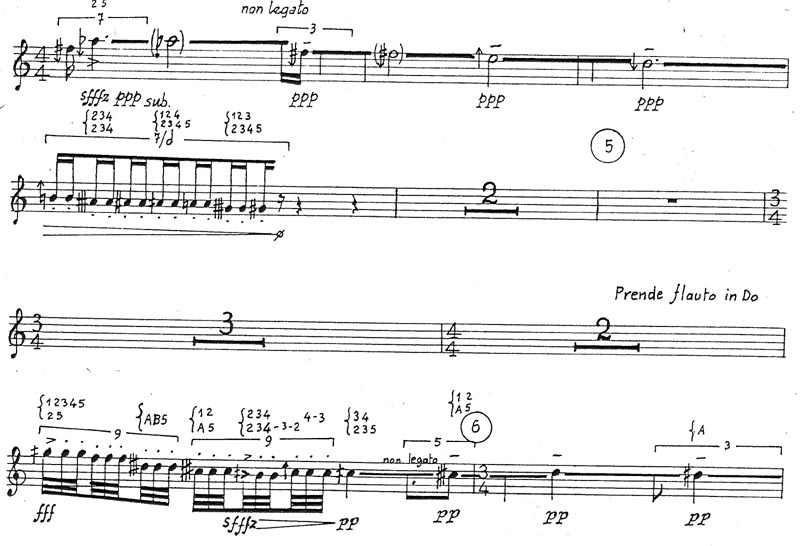
A tongue or lip pizzicato does not add volume to a note (especially in an ensemble context), and is never louder than an ordinario note played at the same volume. It is a misconception to think that starting a note with a pizz will intensify its initial volume. A really forceful accent with the airstream, or with the langue sorté, will do the job better. In a solo work, a pizz will give a satisfying pop, and is an effective way to vary articulation. This pop is produced by closing off the resonance of chest cavity and most of the flute tube (since there is minimal air traveling down it), and is not compensated by the meager resonance inside the mouth.There is no air stream to project the sound. This is why I am frustrated by the following passages, where if I play a true pizz, I get a lessening of volume and intensity – just the opposite of what is musically called for:
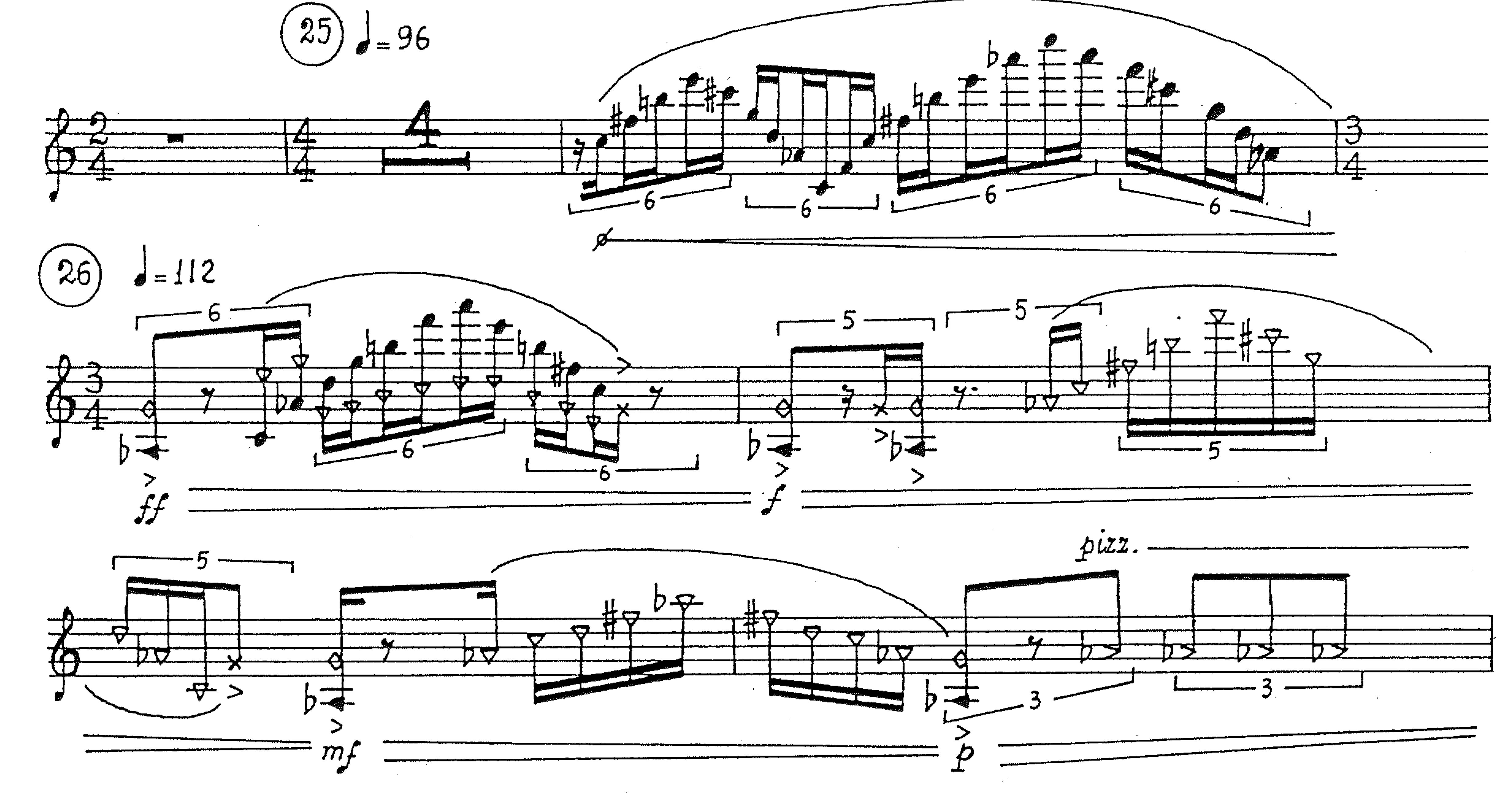
This next sample shows a similar volume difficulty with the tongue ram at the end of a crescendo on the downbeat of 26, along with the difficulty of switching quickly from closed embouchure position to open in the two bars after 26. And I have to ask, who the hell is going to hear those key clicks? This is why they fall so often into my “why bother” category of techniques. Great use of pizzicato here, though.
Why am I bothering with such small things? The musical intentions of the composer are clear, and one can easily perform the gesture with alternatives. However, students of flute and composition are getting younger and younger. Our youth ensemble is tackling repertoire I never dreamed of when I was in my teens. They may not have the experience to immediately grasp what is needed musically. They will, at first, take the score literally, thus getting frustrated. If their teacher is also inexperienced, there will be a double frustration and the trust between composer (alive or dead) and performer damaged.